


The BREAKAWAY is for getting off the wheel. Longer thoughts on cycling, culture, and taste. Less reaction. More distance.
You can follow us on Instagram here but in its purest and most beautiful form this is a newsletter, something to slow your timeline down.
Before we get into it
GRAVITYHILL is free to read and always will be. But if you are getting something out of it, a subscription goes a long way toward keeping this independent.
In case you missed it, here is what we have been working on:
BREAKAWAY // 002 — A Sharpie, a Hack, and 150 Years of Castelli
A Norwegian rider blacked out a logo with a marker in 2009. Castelli turned it into a product. Then half the peloton showed up at Milan-San Remo in one. How the most important cycling garment of the last twenty years started as a fix and became infrastructure.
A playlist that is a little all over the place and completely selfish. Songs we have been living with for years. For the last few indoor training sessions before the roads open up.
FEEDZONE // 003 — The Vest Situation
The piece of kit nobody photographs and everybody reaches for. Six brands that actually figured out what a vest is supposed to do
No affiliate links. No paid placements. No sponsored content. Everything we write about and put in front of you is either something we genuinely believe in or something we believe the culture needs to be talking about. That has always been the deal.
If that sounds like your kind of newsletter, you know what to do.
Today a WorldTour rider knows exactly what is in every bottle coming through the car window. Grams of carbohydrate. Milligrams of sodium. Timing mapped to the km. Nothing left to chance. Nothing improvised.
A hundred years ago, a rider in the same race would stop at a roadside bar, lean his bike against the wall, walk inside, and order wine.
Not as a protest. Not as a bit. Because he was thirsty and the café was there.
The very first Tour de France in 1903 set the tone immediately. Maurice Garin, the man who won it, rode with a cigarette in his mouth and stopped at bars along the route to refuel. Not once. Regularly. He credited wine, hot chocolate, and oysters as essential to his preparation. Cycling’s inaugural champion was essentially running on a moving picnic.
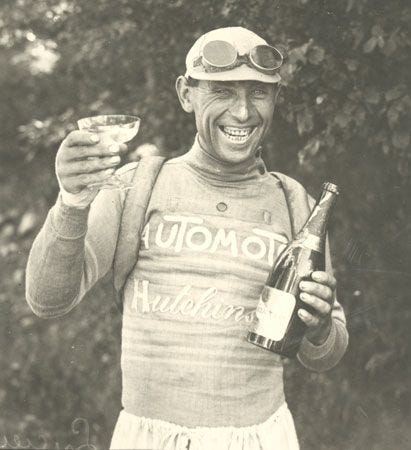
The following year, 1904 winner Henri Cornet fuelled himself on champagne, hot chocolate, tea, and rice pudding. Every single day. Cornet was nineteen years old and is still the youngest Tour winner in history. He won on a diet that would get a modern rider pulled from the race by their nutritionist before the first mountain stage.
In those early years the Tour took no responsibility for feeding the riders at all. They were expected to make their own arrangements. Breakfasts at cafes. Bread from farms. Whatever they could carry or find. The race went straight through towns and the towns were part of the race.
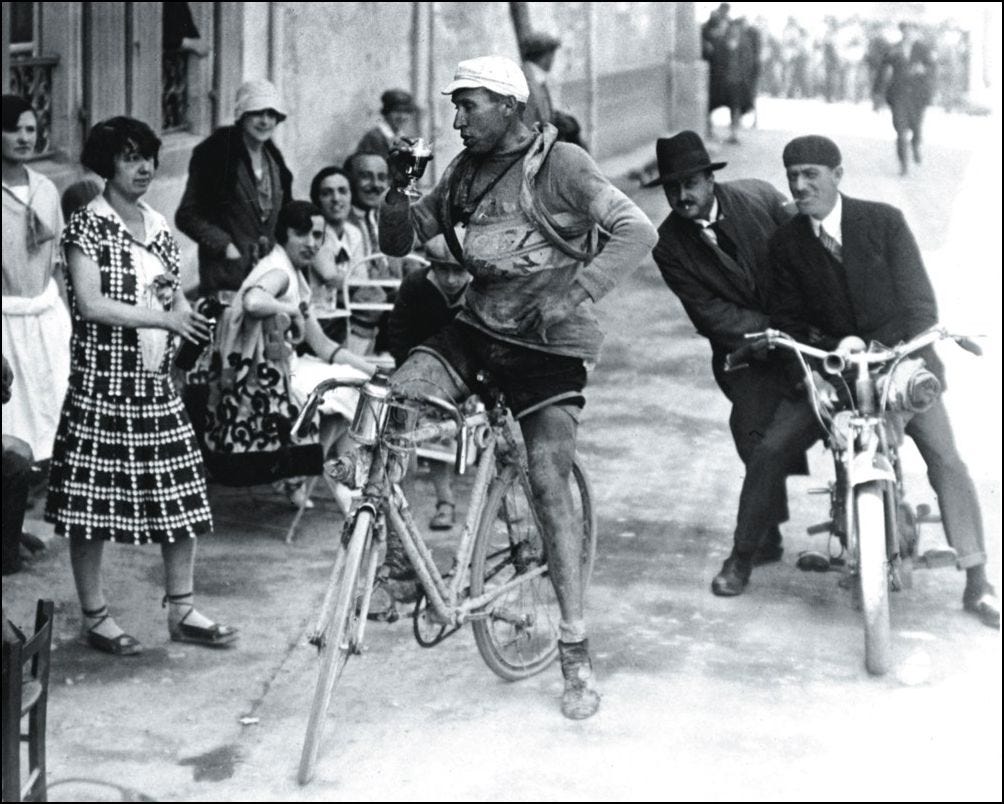
Wine was fuel. Beer was hydration. Champagne sat somewhere between the two. And alcohol was often a safer bet than water. This is not a joke. Rural France in the early 1900s had no guarantee of a clean supply. Village water came from whatever was available. Streams. Old pipes. Wells that had not been tested by anyone. No treatment. No regulation. Nothing standing between what went in the ground and what came out the tap. Fermentation killed what was in it. A bottle of wine that had been through that process was genuinely safer to drink mid-stage than a cup of water from a roadside pump that nobody could vouch for. Riders were not being reckless. They were being practical. The science backed them up even if they did not know it yet.
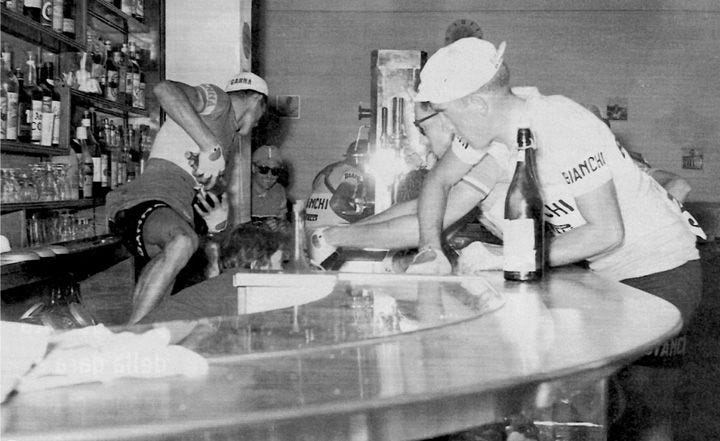
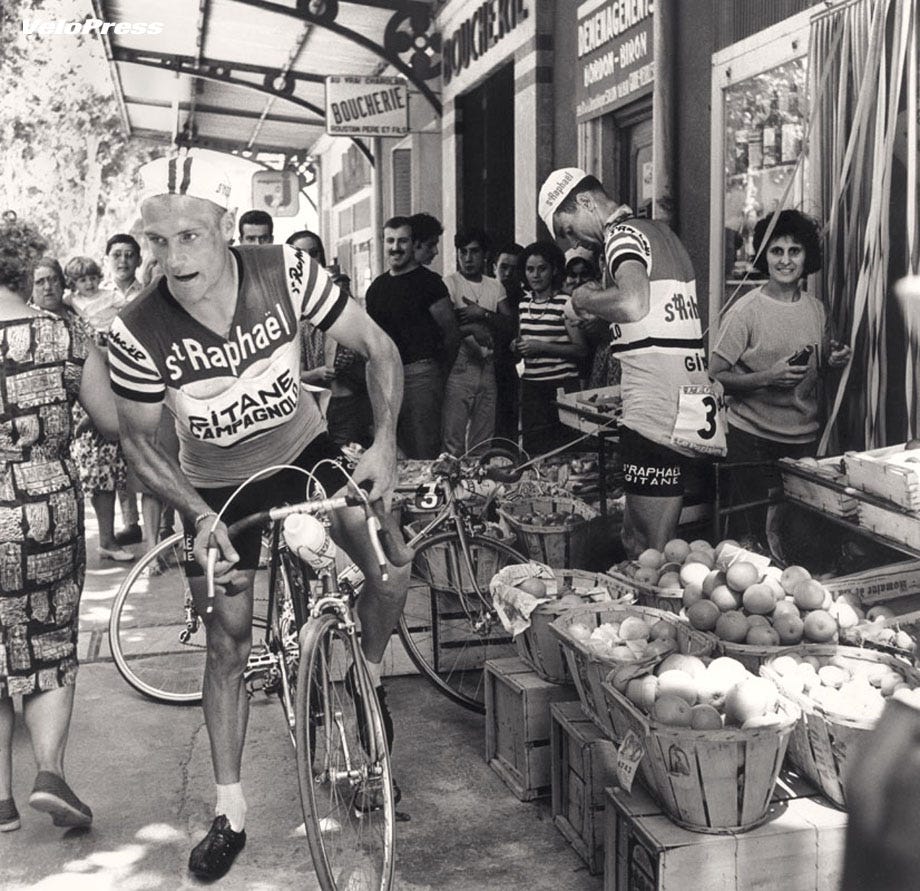
By the 1960s the practice had its own name. La chasse à la canette. The can hunt. Louis Malle documented it in his 1962 film Vive le Tour, calling the drinking raid one of the most important moments of the race. The footage is something. Riders flying off bikes, shouldering through cafe doors, ransacking the bar for wine and beer and champagne, anything with calories, then disappearing back onto the road with glass bottles stuffed in jersey pockets and silver foil champagne tops catching the light.
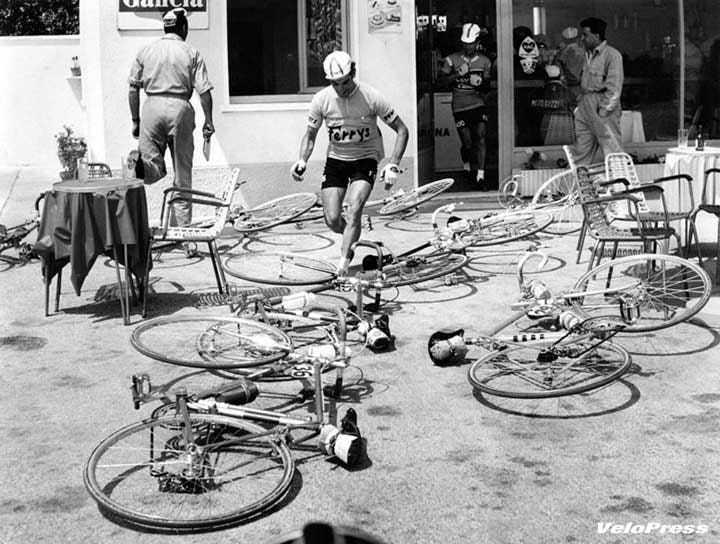
They did not pay. The Tour organisers settled the bill at the end of the race. The bar owner got reimbursed and got a story he would retell for the rest of his life. The riders got back in the peloton ten minutes down and made it up. That was the deal.
Team leaders did not even do the raiding themselves. That was the domestique’s job. The captain would bark the order and the raiding party formed around him. Fetching the bottles was part of the service. One of the unwritten perks of being a leader on Tour. It was never your round.
The story that captures all of this perfectly happened in 1935. Stage 17. Pau to Bordeaux. Baking July heat through southwestern France. Somewhere along the route, spectators had set up a table by the roadside loaded with beer for the peloton. An offering. A gesture. Completely irresistible in the circumstances.
Almost the entire peloton stopped.
One rider did not. Julien Moineau drifted quietly away from the group as everyone else reached for a glass, slipped into a gap, and put his head down. He had organized his own water stops in advance. Some people have suggested he may have also organized the beer table, though he never admitted it. He won the stage by fifteen minutes and thirty-three seconds. One of the largest winning margins in Tour history. The whole peloton, outmaneuvered by a cold beer and a plan.
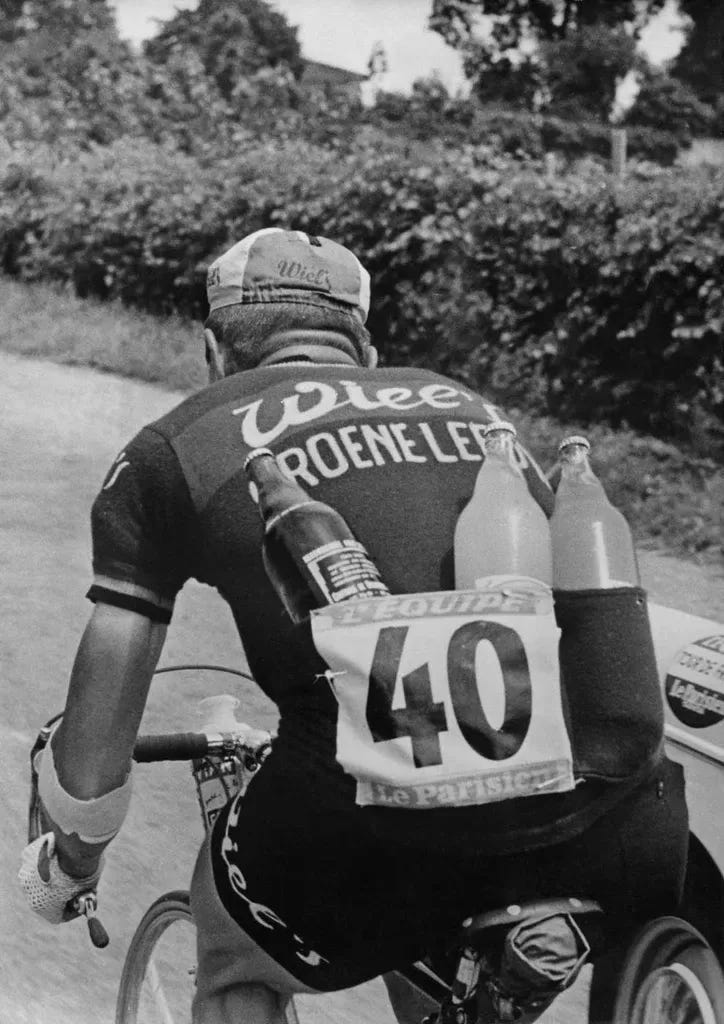
Café raids faded slowly. Not because they were banned outright, but because everything around them changed. Team cars became common. Feeding zones standardized. Nutrition science arrived. Gatorade was developed at the University of Florida in 1965. Cycling took a while to catch up, characteristically, but it got there. Sponsors wanted control. Television wanted predictability. The race tightened.
By the time gels and energy drinks took over, stopping at a café mid-stage felt unthinkable. Dangerous. Out of sync with what cycling had become. The café was no longer part of the course. It became something you visit after the ride.
Something was gained though. Speeds went up. Today’s riders consume upward of 120 grams of carbohydrate per hour, more than double what the science recommended a decade ago. Their guts literally retrained to absorb that much fuel. What the human body can do across three weeks of racing in 2025 is not the same sport as what Garin and Cornet were doing on unpaved roads with wine in their pockets. The results are not up for debate.
But something was lost too. Not alcohol. Informality.
The café raid belonged to a moment when cycling had not fully separated itself from the world it moved through. The race accepted interruption. Riders adapted to what was there instead of eliminating every variable. Towns were not just backdrop. They were infrastructure. Spectators were not watching from behind barriers. They were handing over bottles and laying out beer tables and settling up with the bar owner at the end.
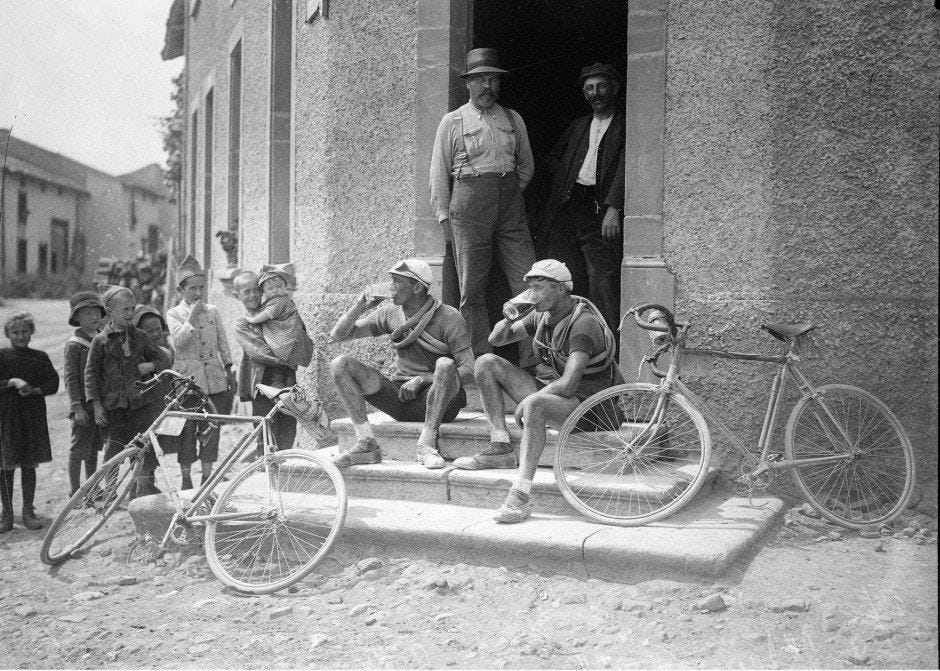
That image feels foreign now. Modern cycling is a controlled environment. Every variable monitored. Nothing improvised. The race exists inside a bubble the sport spent a century building and the bubble works. There is no romance in bonking because you thought vibes were enough.
The café raid stories are not a counterargument to any of that. They are context. Texture. A reminder that the first Tour winner stopped at bars with a cigarette in his mouth and won anyway. That a nineteen-year-old fuelled himself on champagne and rice pudding and became the youngest champion in history. That an entire peloton once stopped for a cold beer and got beaten by fifteen minutes by the one rider who did not.
Most of us are not stopping mid-ride to grab a beer (maybe, sometimes). We are stopping after. Bikes leaned up outside. Shoes still on. One drink turning into two. Talking about the ride while the body comes back down.
That is where the café raid lives now. Not as a tactic. As a tone.
Cycling grew up. It got faster and more precise and more demanding and all of that is correct. Cycling optimized everything it could find. Somehow it never got around to the café. We are certainly not complaining.
To submit a site, product, or whatever you’re working on, email KMC@GRAVITYHILL.CC. We read everything. Posting is never guaranteed, but curiosity always is.
This was very entertaining