


The BREAKAWAY is for getting off the wheel. Longer thoughts on cycling, culture, and taste. Less reaction. More distance.
You can follow us on Instagram here but in its purest and most beautiful form this is a newsletter, something to slow your timeline down.
BEFORE WE START
GRAVITYHILL is free to read and always will be. But if you are getting something out of it, a subscription goes a long way toward keeping this independent.
In case you missed it, here is what we have been working on:
LEFT TURNS // 004 — WHO MADE THAT KIT Every WorldTour and ProTeam kit supplier for 2026. Men and women. In one place.
MOODY BOARDS // 005 — GIRO D’ITALIA No explanation. No context. Just the feeling.
BREAKAWAY // 005 — Cycling Has a Visibility Problem Ben Healy has 105,000 followers. Lewis Hamilton has over 40 million. That gap is not about talent. How fashion became the entry point for every sport that cracked the culture problem — and why cycling has not run that playbook yet.
If that sounds like your kind of newsletter, you know what to do.
The Giro is by far my favourite race in the calendar. Not only for what it is, but for what it means. For what it represents. My family is from Fossacesia. A small town on the Adriatic coast of Abruzzo. My wife and I got married there a few years back. Over the holidays a few years ago, my mom’s uncle told me that growing up, him and his brother used to cycle all over those roads. His brother got good enough to race. He apparently turned pro in the fifties. Apparently even did the Giro. I was never able to find anything to confirm it online, so we are just going to have to believe it. Fossacesia is in the same region as the Blockhaus, the majestic climb that defines the first week of the Giro every time the race comes through the region.
The love for this sport did not come from nowhere. It came from somewhere specific.
I grew up in Montreal. Born here. Live here. But I grew up Italian. My parents, my sister, my nonno and my nonna, we spoke Italian at home, we ate Italian, our whole culture was Italian even though we lived in a French-Canadian city. I even went to Italian school on Saturday mornings. My whole circle of friends grew up the same way. We have always identified as being Italian over Canadian.
Growing up though, soccer had every ounce of my attention. Played it every day, watched AS Roma on the weekends, still do. I idolized the Azzurri. Totti, Maldini, Nesta. The golden age of Italian soccer. Cycling came way later in my life, after wrecking my knee a few times and realizing that soccer was not worth playing anymore. Surgery can do that to you. Once I got my first road bike and some friends did the same, everything changed. The first race I ever watched was the Giro. I did not really understand the sport at that point yet (especially the tactics of it) but I fell in love with how Italy was being portrayed through the race. How they spoke about the food, the wine, the weird little stories to fill up TV time. The country that mostly shaped who I am being shown to me through a camera on the back of a motorcycle at speed. The light. The roads. The crowds on hairpins. Italy is not just the backdrop. It’s the whole point.
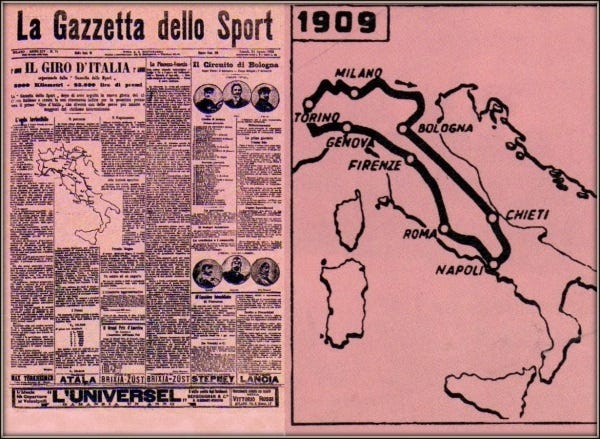
The Giro d’Italia was born in 1909 as a marketing scheme. That’s the honest version. La Gazzetta dello Sport was a struggling sports newspaper in Milan, printed on pink paper because pink was the cheapest stock available. Their rival, the Corriere della Sera, had used an automobile race to drive circulation and it had worked. The Tour de France had launched in 1903 for the same reason, built by a French paper called L’Auto to sell copies. Tullo Morgagni, the editor of La Gazzetta, saw what a national race could do and sent a telegram to his cycling editor in Venice. Four words in Italian. Senza indugio, necessità obbliga. Without delay, necessity obliges.
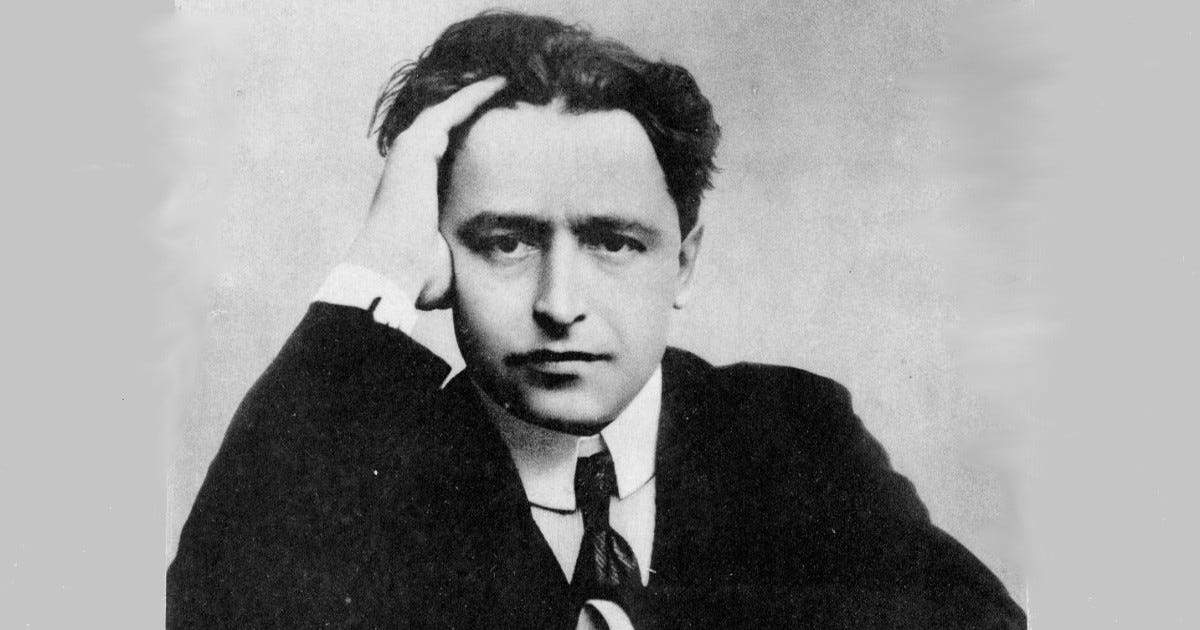
Tullo Morgagni
They had no money. The paper could barely make payroll. They announced the race anyway, across seven columns on the front page, then sent an accountant named Primo Bongrani around Italy with a hat asking for donations. Even the Corriere della Sera, their direct rival, gave them 3,000 lire. Roughly two months of a working person’s salary at the time.
On May 13, 1909, at 2:53 in the morning, 127 riders left from outside La Gazzetta’s offices in Milan and attempted stage one out of eight. The first stage was 397 kilometers to Bologna. The roads were mostly dirt. The bikes weighed as much as small children. A mass crash happened before dawn, less than two kilometers from the start. The first ever stage winner was Dario Beni and he won it in roughly fourteen hours. That is the beginning of the Giro.
Dario Beni
The Italy we know now was very different than the Italy that was around when the Giro started. As a unified nation, the country was only 48 years old. Before 1861 there was no Italy, per se. There was the Kingdom of Sardinia in the north, the Papal States in the center, the Kingdom of the Two Sicilies in the south, and a collection of duchies and foreign-controlled territories that happened to share a peninsula and a language. The Risorgimento had stitched them together on paper. On the ground the divisions were still raw. A factory worker in Milan and a farmer in Calabria shared a flag and almost nothing else. To the first Giro fans, riders were not Italian. They were from Asti. From Novi Ligure. From Cittiglio. The region, or commune, came before the nation. It always had.
Morgagni understood this and routed the race deliberately. Not just through the north, where the fans and the passable roads were, but all the way through Italy. Down to Naples and back. Through towns that had never seen a bicycle race. Through regions that had no reason to feel connected to anything happening in Milan. But the People came out, and they came out in numbers. Farmers. Merchants. Fishermen. Standing on dirt roads watching riders from their region and riders from places they had never been to moving through the same landscape together. The Giro did not set out to unify Italy. It set out to sell newspapers. Somehow, it managed to do both.
By 1911, just the third edition, the organizers moved the start and finish to Rome to celebrate Italy’s 50th anniversary of unification. The race had become something much bigger than a sporting event in just two years.
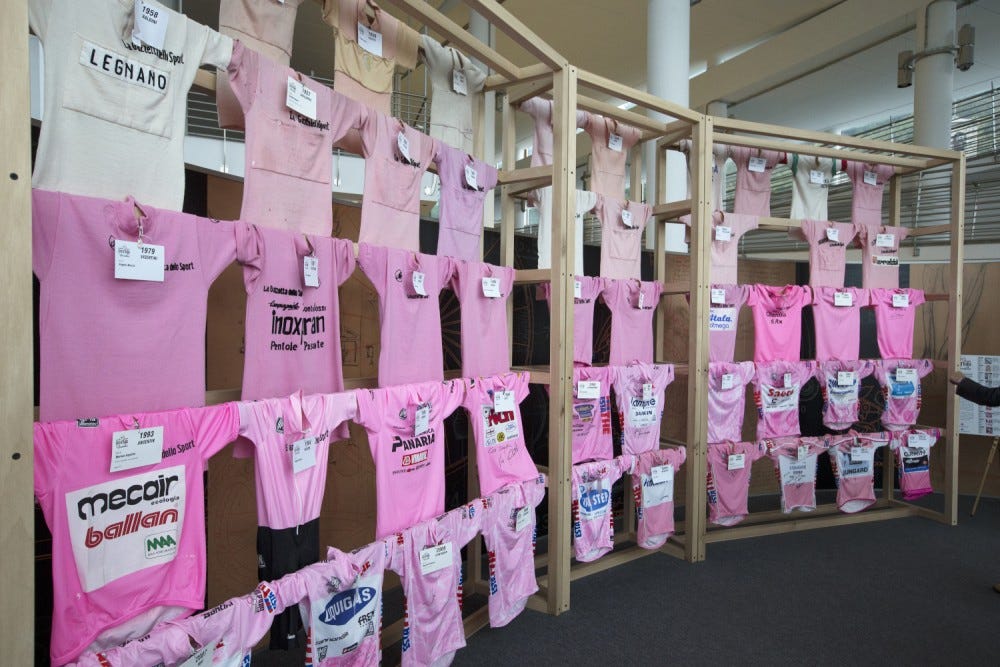
The pink jersey came in 1931, twenty-two years after the first race. The maglia rosa. The reason it is pink has nothing to do with romance or intention. La Gazzetta printed on pink paper because it was the cheapest stock available at that time. That is it. A budget decision at a broke newspaper became the colour of the most recognizable jersey in the sport. It just happens, the way the best Italian things tend to.
Then came the war. Two of them. The Giro stopped during both. When it came back in 1946 the country was rubble and chaos. The roads were craters. Italy was trying to figure out what it was now, what it stood for, who was in charge. And into all of that walked two cyclists who could not stand each other and could not stop racing one another.
Fausto Coppi was from Piedmont. Secular, precise, obsessive about diet and training in a way nobody had been before. Cold in person, extraordinary on a bike. He approached the sport like a science while everyone else was still treating it like a suffering session. He was a hero of the industrial north.
Gino Bartali was from Tuscany. Conservative, deeply Catholic, blessed personally by three popes. He believed suffering on a bike was a form of devotion. Warm in public and suspicious in private. The rural south venerated him. They were teammates on the national team and barely spoke.
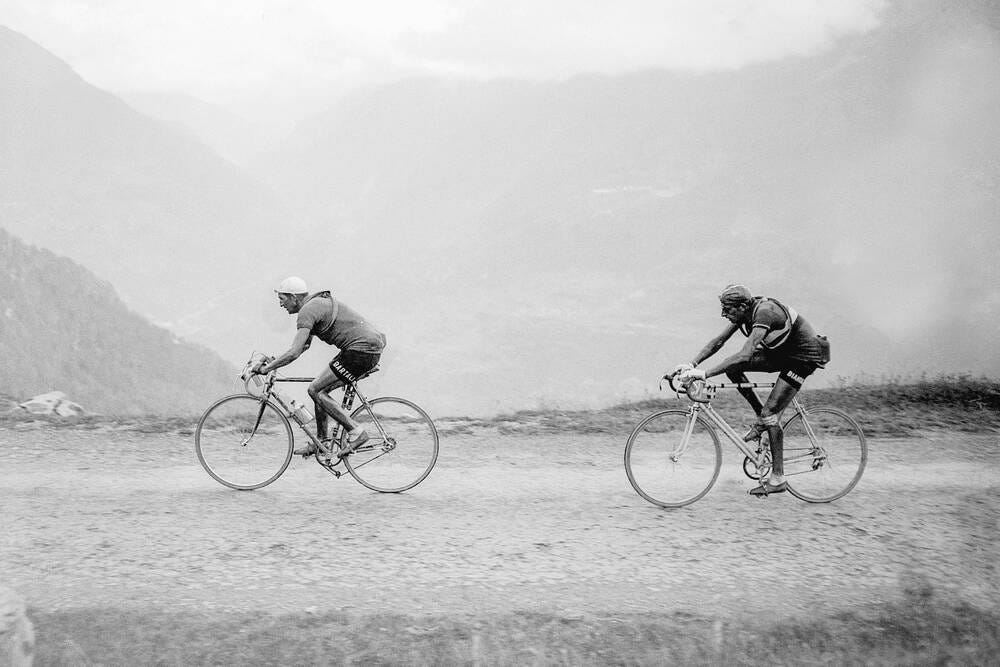
Coppi and Bartali in the Italian Alps.
Bartali booked hotel rooms next to Coppi’s and managed to go through his room for bottles, phials and tubes before some stages looking for evidence of doping. During a mountain stage of the 1946 Giro, Coppi drank from a glass phial mid-race and threw it into the bushes. Bartali retrieved it, put it in an envelope and sent it to a lab. It came back as a French tonic available to the public without a prescription. At the 1948 World Championship in Valkenburg they were both in the lead group on the final lap. Neither would ride for the other. Both climbed off the bike rather than help the other one win. The gold medal went to a Belgian.
The writer Dino Buzzati covered the 1949 Giro for the Corriere della Sera having never written about cycling before. He used military language. Achilles and Hector. Two men carrying the weight of a divided country across three weeks of mountain roads while Italy watched from the roadside and chose a side to root for.
Coppi left Bartali by eleven minutes on a single stage. Cuneo to Pinerolo. Eleven minutes. Coppi was the north. Progress, industry, the secular future. Bartali was the south. Tradition, faith, the old Italy. A country still trying to convince itself it was one thing watched these two men and picked a side. Most of them never switched and the rivalry was never resolved.
Fiorenzo Magni in 1956, crashed and broke his collarbone mid-race, his right arm completely useless, no way to grip the handlebar. He looped an inner tube around the bars and bit down on the rubber with his teeth, absorbing every cobble and every pothole through his jaw for the rest of the stage because abandoning was never a consideration. He finished. Not for the stage win. Not for the time. For the race. For the jersey. Because that is what the Giro asks of you and Magni was not the kind of man who said no to that.
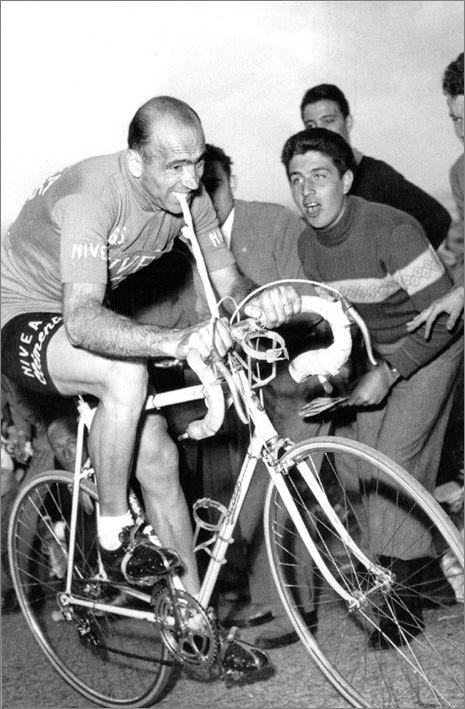
The famous Magni Bite
Chris Froome in 2018. Down three minutes with three days left, which usually is unrecoverable, attacked alone on the first climb of Stage 19 and rode eighty kilometers through the Dolomites completely by himself. Simon Yates, who had worn the maglia rosa for thirteen consecutive stages that year, lost over thirty-eight minutes that afternoon. He also lost the jersey.
Seven years later, at the 2025 Giro, Simon Yates came back to the Colle delle Finestre. The same climb. He attacked on the gravel roads near the top, dropped everyone, set a new record up the mountain and won the race overall by nearly four minutes. The Finestre had defined his career once already. He went back and redefined it himself. Its hard not to be romantic when you hear stories like that.
The Dolomites do this. They are not like any other mountains in cycling. They come at you in walls. Short, brutal, relentless climbs that strip away tactics and team support and leave only the rider and whatever they have left. And the crowds. There is no crowd in cycling like a Giro crowd. They line hairpins in the middle of the night to be there at dawn when the race comes through. They paint the roads. They build shrines on the mountainside. They do not watch the Giro. They inhabit it.
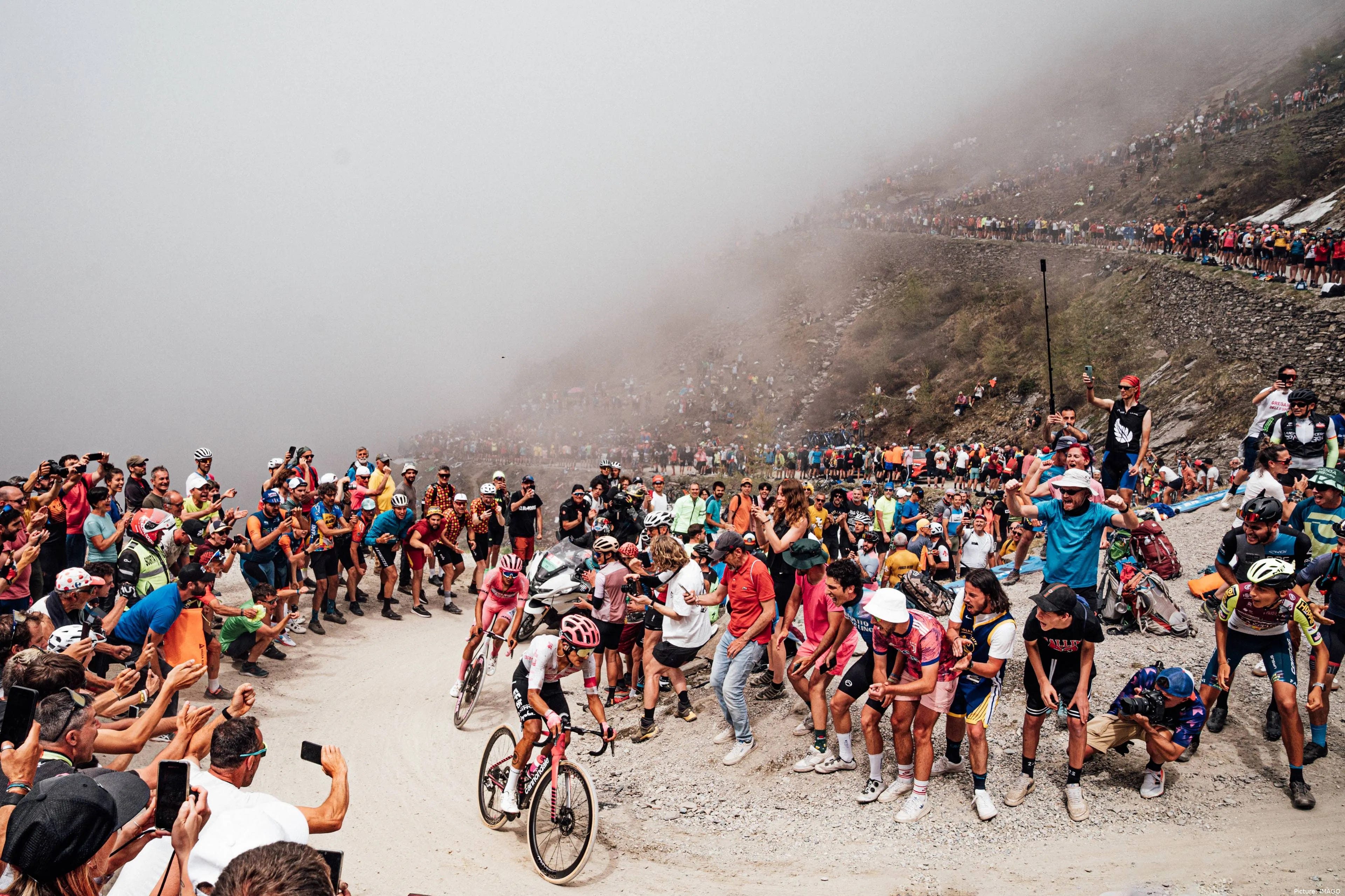
The highest point of each Giro is called the Cima Coppi, named after the great Fausto Coppi. The first rider to crest it takes the award. Coppi won this race five times. He got sick after a hunting trip in Africa in 1959. His doctors could not figure out what was wrong. Nobody thought to test for malaria. He was a European cycling champion. He’s been through hell multiple times. It did not cross their minds. He died on January 2, 1960. He was forty years old. Every year at the top of the hardest climb his name gets painted on the road and the peloton rides over it.
In 2023, the Giro started from Fossacesia Marina. Stage one. A 19.6-kilometre time trial along the Costa dei Trabocchi to Ortona, past the trabocchi, the fishing platforms built on stilts above the Adriatic that have been there for centuries. Won by Remco Evenepoel, who took the first maglia rosa of that edition in the town where I got married. The town my family grew up in. A few kilometers from the mountain my great-uncles rode after the war for no other reason than because it was there and they had bikes and they were alive.
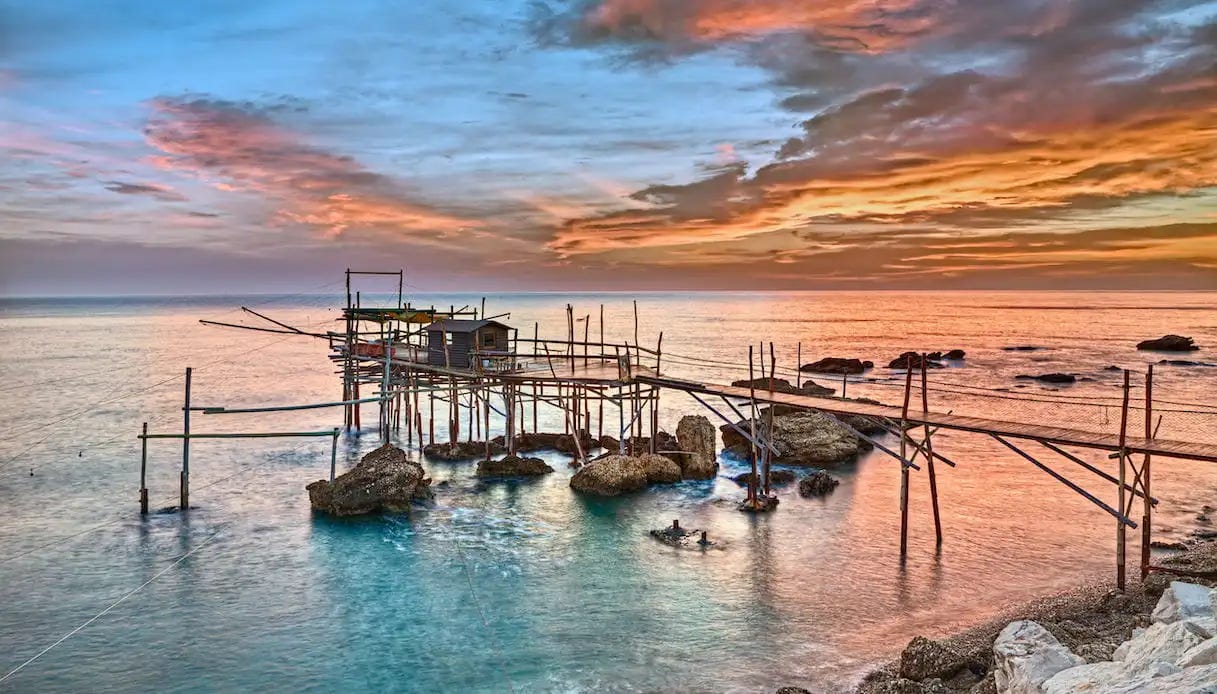
1 of 23 Trabocchi left on the Adriatic coast in Abruzzo.
The 109th edition starts today. It begins in Bulgaria before crossing into the south of Italy, moving north through the Apennines, into the Alps, into the Dolomites, finishing in Rome. The Blockhaus is on the route. Stage seven. Rest assured, we will be on the couch in Montreal, in a city that is not Italy, but in a home that always was.
To submit a site, product, or whatever you’re working on, email KMC@GRAVITYHILL.CC. We read everything. Posting is never guaranteed, but curiosity always is.
Unrelated but I need to know your opinion as an Italian Montrealer - is Cafe Olimpico the real deal or just a trendy spot
Beautifully written, thank you. Looking forward to seeing this next three weeks of beautiful racing.