


The BREAKAWAY is for getting off the wheel. Longer thoughts on cycling, culture, and taste. Less reaction. More distance.
You can follow us on Instagram here but in its purest and most beautiful form this is a newsletter, something to slow your timeline down.

Global warming seems to be a (very) controversial topic lately, but I think there’s one thing we can all agree on: summers are getting warmer and sporting events are getting tougher and tougher on all athletes. We are seeing it in tennis. We saw it during the World Cup, with those (very dumb) cooling breaks, and we are now seeing it in cycling. It seems to be the main topic of conversation for the sport right now. Especially in Grand Tours.
On stage one of the Tour de France this year, it was over 30 degrees. Now, we’re not sure if you’ve ever attempted to do an all out effort during a heatwave, but that sh*t can kill you. During that stage, UCI officials were pulling riders aside one at a time behind the start ramp and making them take the ice out of their jerseys.
What they were removing were ice socks, which is basically a pair of tights cut down, stuffed with ice cubes, tied off at both ends and shoved down the back of the collar so the melting water cools the blood running close to the skin. Most of the peloton uses them. It’s very prominent in the (professional) cyclosphere.
The rule the cyclists were “breaking” is Article 1.3.032, which basically says clothing cannot modify the rider’s morphology. It’s an anti-cheating rule. Nobody was arguing the ice was dangerous or unfair on health grounds. The concern was that a sock of ice fills in the gap behind a rider’s neck, and that’s a free watt or two (minimal gains!).

The commissaire’s explanation was that you have to draw the line somewhere. But do you?
It stuck for the first stage and quietly evaporated after that. Riders were using them again on stage 2 and nobody said a thing. Who’s going to say something when it’s 35C+?
I kept watching and it was the same story over and over again for three weeks. 36 degrees on stage three with wildfires 70km from the finish. Forecasts were touching 40 for the Carcassonne start. Pogacar called the whole cooling operation a logistical nightmare and said core temperatures were getting dangerous. Riders were dunking their forearms in tubs of iced water, eating frozen carbohydrate gels on the start line, spraying themselves with alcohol (not the drinking kind), squeezing bidons over their heads, warming down in ice vests. Tom Pidcock spent $995 on cooling mitts. Netcompany-Ineos had riders resting their forearms in water just above freezing temperature, which cooled the blood without cooling the leg muscles they’d just spent twenty minutes warming up.
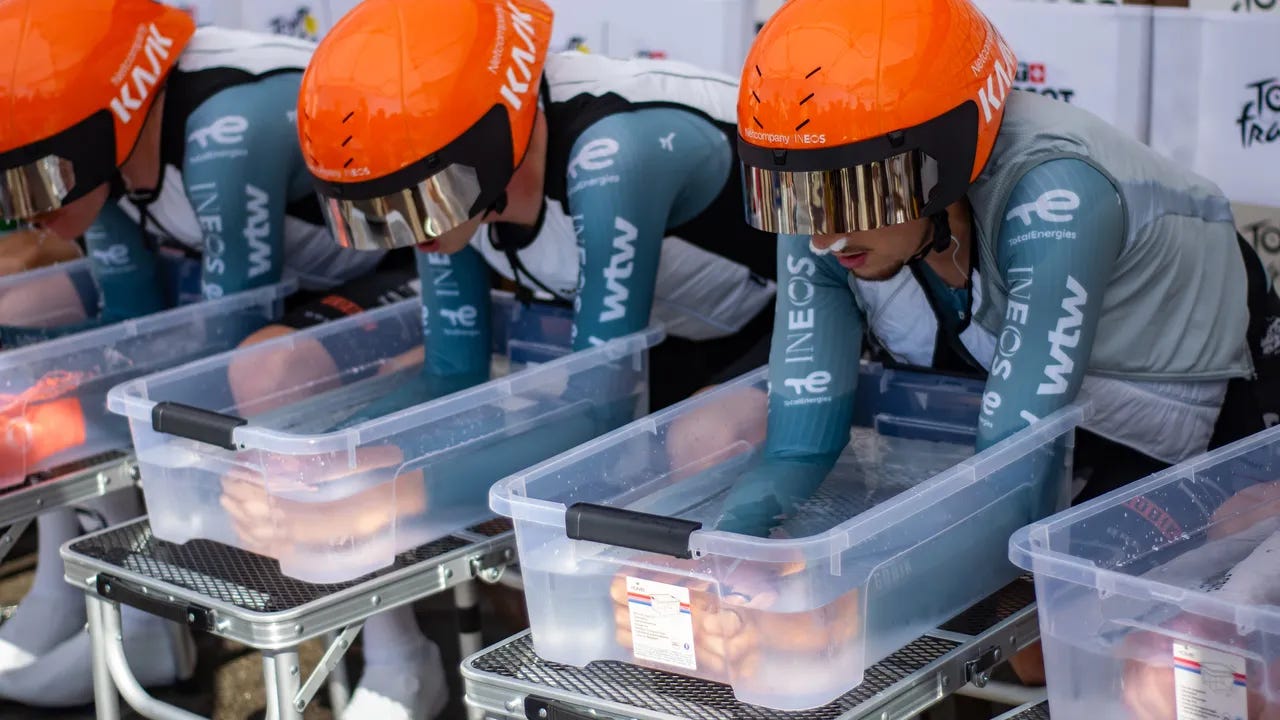
The UCI had to adapt, so they relaxed the feed zone rules so teams could get bottles and ice out to riders more freely, and the race put another motorbike on the road purely to distribute ice and cold water bottles.
This is where it all gets interesting to me. The response to extreme temperatures was simply better hydration and ice distribution. Did anyone look at the clothing? The fabric? I don’t think so. I know that’s kinda hard to change in the moment, obviously, but it did have me thinking.
So we did some research and as it turns out, it isn’t that cycling stopped developing fabric. It develops plenty, actually. It’s just that all of it points one way.
WHAT THE INDUSTRY ACTUALLY CHASES
Cycling fabric R&D is pointed at watts. Almost all of it. Watts sell, so watts get funded.
Heat got marketed under comfort for decades. It was the kind of thing a mesh back panel would take care of, or making a zipper less jersey so thin it looks like a base layer and charging you $300 for it (looking at you, PNS). That all seemed to work until this summer, when heat turned into a race-deciding variable.
Running figured this out a little faster. Maybe that’s capitalism, or consumerism, if you want to call it that. They need to innovate in order to sell. It makes sense when you think about it. A runner has no bike to hide behind and no wheels to upgrade, so the shirt and the shorts, the fabric, is the only real variable there is. It’s the only thing they can buy and swap out.
Some of that is also due to simple physics though. Your cycling kit has to solve four problems at the same time. Shed heat, cut drag, kill friction, and hold its shape and position across loooong hours on the saddle.
And those four fight each other. Aero fabric is tightly woven, and tight weave means less air moving through it. Cooling fabric is open, and open is slower. Compression restricts breathability. Durability adds weight. There isn't a single fabric that wins in all four categories, so every garment ever made is a trade-off, and cycling has always settled that trade-off in favour of speed.
WHY IT WENT THIS WAY
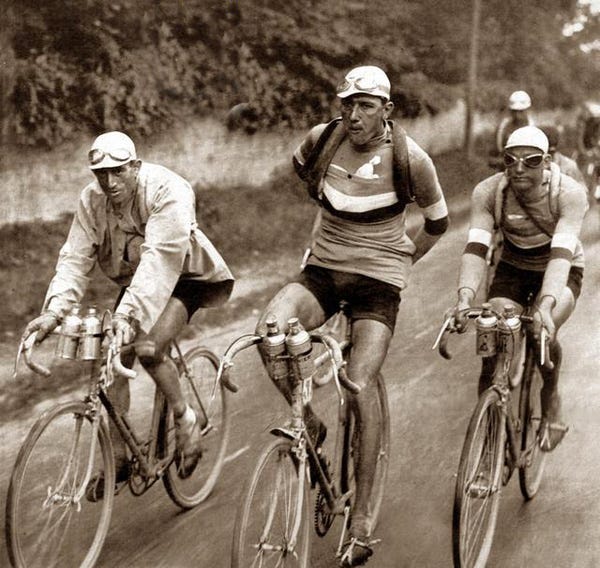
Cyclists used to race in wool (imagine the chafing!). It absorbed everything, weighed a tonne wet, and was aerodynamically catastrophic. The chamois was real leather, rubbed with emollient (yuk) before every ride and dried carefully after.
Then in 1976, an engineer named Toni Maier brought a bike frame he designed into a wind tunnel in Zurich to get some real data, working with engineers from the Swiss Federal Institute of Technology. The frame was very radical for its time. It had teardrop tubes and it was made out of carbon fibre, which was a material so new and tightly controlled that Maier had to sign a letter with the manufacturer promising not to sell any of it to Russia (this was during the Cold War, after all). What the wind tunnel actually revealed was surprising to him. The biggest factor in aero performance wasn’t even the frame, it was the rider position, which led him to fit the world’s first cow-horn aero bars. But there was still a massive drag problem left to solve. The clothes. Those baggy wool clothes everyone raced in.
They tried a naked rider first, just to see what the body alone did in the tunnel. But that didn’t give them an answer, so it got them thinking about fabric. Maier’s wife, Eliane, was a trained textile technician, and she teamed up with a downhill ski clothing manufacturer to solve the same issue. Late in ‘76, the first ASSOS (of Switzerland) Lycra shorts came into existence.
The British-Dutch team Ti-Raleigh raced in them first, and by the end of the decade the whole peloton had switched to Lycra. Fignon won the 1984 Tour wearing ASSOS.
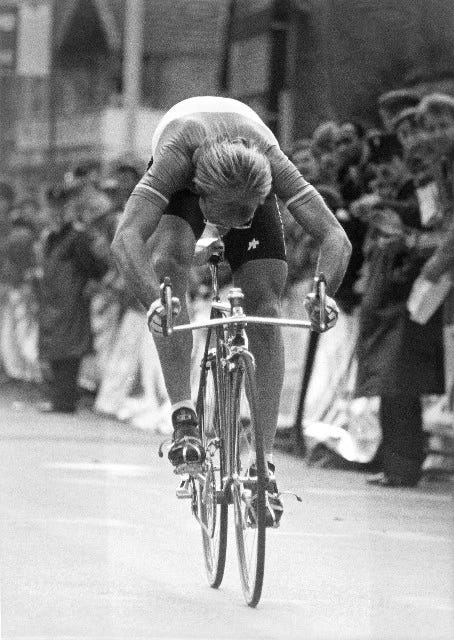
Fignon in 84, wearing Assos.
WHAT YOUR KIT IS (MOSTLY) MADE OF
Lycra, elastane and spandex are three names for the same fibre. They are not three different things. Lycra is DuPont’s brand name for it. Spandex is what Americans call it generically. Elastane is what shows up on a European tag. Chemically it's all the same polyurethane-based fibre, invented by a DuPont chemist named Joseph Shivers and hitting the shelves in 1958. It stretches five or six times its own length and snaps back, and it has to be at least 85 percent polyurethane to legally be called elastane. Decent bibs run 15 to 20 % of it, and the other 80 is basically a two-horse race between polyester and polyamide.
Polyester barely absorbs water. It absorbs about 1 percent of its own weight. Sweat never really gets inside the thread, it gets pulled along the channels between fibres by capillary action and dragged to the outside to evaporate. Polyester microfibre moves water 35mm in 60 seconds in lab testing. Which means it dries fast, costs less, and lasts a long time. The main downside is it runs warm on long efforts, and because the sweat sits on the surface, so does the bacteria. That is why your “cheap” jersey usually smells worse than your good (read: more expensive) one.
Polyamide is just nylon, with a nicer name. It absorbs water a little more at the fibre level but moves it off your skin faster. It’s softer, stretches better and has much higher abrasion resistance, which is why the seat panel on a great bib is almost always polyamide-heavy. It dries a tad bit slower and it costs more.
Good bibs sit at 80 to 85 percent polyamide. Cheap bibs flip that toward polyester to save money. You probably wouldn’t notice the difference in a ride or two, but you probably will after a dozen of them.
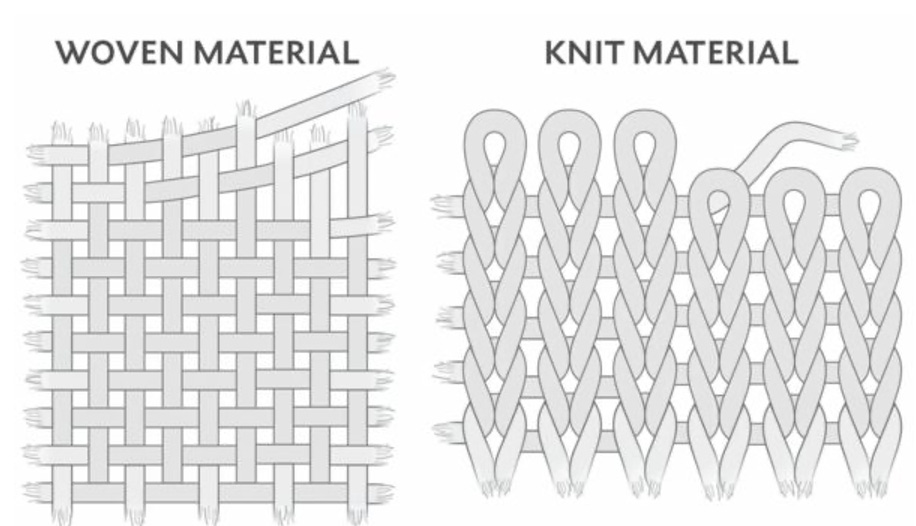
Then there’s knitted versus woven, which nobody bothers to explain and which might matter more than the fibre itself. Knit fabric is built from interlocking loops, which is why it stretches, that’s the whole mechanism behind every bib short and jersey fitting close to the body. Woven fabric is threads crossed over each other at right angles, tight and stable. It has almost no give unless you weave elastane straight into it. Almost all cycling fabric is knitted, for the obvious reason.
Luigi Bergamo, who founded Q36.5 (great brand, btw), went the other way and pushed woven into the sport. The point of it connects straight back to the heat problem. A membrane is what usually gets you wind protection on a knit fabric, and a membrane is also a near-solid barrier that kills breathability. Woven fabric blocks wind through the tightness of the weave itself, no membrane required, so you get the wind protection without paying for it in trapped heat.
The catch is that your average fabric mill isn’t set up to produce woven fabric for cycling, so the brands doing it are developing these fabrics at their own expense and passing that cost back to you. In simpler terms, it’s really expensive.
THE NUMBER NOBODY PRINTS
GSM. Grams per square metre. Cut a square metre, weigh it, and that’s the golden number. It’s measured under a standard called ISO 3801 so it compares across brands.
Summer jerseys sit at 120 to 160 GSM. Most team kits land at 140 to 160 GSM. Warm weather base layers go to 100. Thermal and winter jump to 200 to 280 and up. Bibs usually run heavier than jerseys because they need opacity and compression that a jersey simply doesn’t need. For reference, a standard year-round men’s wool suit runs around 280 to 300 GSM, so a decent chunk of your winter kit is built out of a fabric heavier than the suit hanging in your closet.
Neither end is better than the other, they just do different jobs. A 130 GSM jersey in November is a mistake. A 240 GSM in July and you’re dying (unless you’re heat training, and even then, you’re dying).
If the GSM is missing, hold the fabric up to a light. A proper summer jersey has an open knit and you should see through it. If you cannot, you will overheat. And be suspicious of any brand leading with fabric weight as their whole marketing pitch, GSM only tells you how heavy something is, not whether it's good quality. A cheap polyester knit and a premium polyamide weave can be the same GSM and perform nothing alike. If a brand won't tell you what the fabric actually is, or how it's woven, that's usually because the number is doing the work that the fabric can't.
HEAT
Your body is a bad engine. Something like 20 to 25 percent of the energy you put through the pedals actually turns into movement. The rest comes out as heat.
And that costs you real power, not just comfort. Studies have measured lactate threshold dropping around 6.5 percent when air temperature goes from 23 degrees to 32C. A simulation of a Tour mountain time trial up Alpe d’Huez, which is an insane way to test something if you ask us, put brain temperature at 39 degrees and leg muscle at 39.7.
The body’s mechanism for dealing with this is sweating, but the sweat itself doesn’t really do anything. It’s the evaporation that matters. Water turning to vapour pulls a serious amount of energy off your skin on the way out. Sweat that just sits there is dead weight, it makes you heavier and then makes you cold later when you stop.
So the entire job of a summer jersey comes down to getting sweat off your skin, spreading it out wide, and getting it to evaporate before it pools anywhere.
ABOUT THE BLACK JERSEY
Visma-Lease a Bike put two Gaudi-inspired jerseys to a fan vote before the Barcelona start. There were over 100,000 votes in three days, the black version won with 52 percent. Then the heatwave hit Spain and France and cycling's online community had some questions. Were they gonna overheat in it?

Mathieu Heijboer, head of performance at Visma, said the team wasn’t worried. They ran prototype Nimbl kits through climate chambers with simulated solar radiation and tested on thermal mannequins that sweat, tracking how fast temperature climbed under the fabric. His conclusion: colour made an insignificant difference to body temperature. Fabric structure, moisture release and fibre treatment mattered far more than whether the jersey was black or white.
That does line up with how fabric science actually works now. Darker colours do absorb more radiation, that part of physics hasn’t changed. What has changed is that modern fabric treatment, UV-resistant coatings that bounce radiation off the rider, structures that pull sweat away fast, has gotten good enough to outweigh the colour difference in a lot of cases.
Here’s the part that’s somewhat shaky. Cyclingnews pointed out that Heijboer never gave the one comparison that would have proven it for Visma’s own kit specifically, the exact same Nimbl fabric in a light version against a dark one. Without that test, you can’t say for certain this black jersey performs identically to the white one.
The riders weren’t fully convinced either. In the days leading to the Tour, they were training in the light jersey, which the team had already built as an official second kit, the Rest Day Jersey.
So take it for what it is. The broader claim, that fabric now matters more than colour, is real and backed by the industry. Whether Visma actually proved that for this specific jersey is a different question, and it’s one that’s still open.
WHAT RUNNING IS DOING ABOUT IT
Satisfy is a running brand going on its tenth year. They have recently released a new fabric called HeatCrush, built on a Japanese mesh, and it’s sweat-reactive, meaning it does nothing at all until you start sweating. When moisture rises through the fabric, the mesh pulls it outward, and heat goes with it. All of this is triggered by your own body rather than by any kind of ventilation.
They also did something cycling brands should be embarrassed about. They tested their fabric on a thermal mannequin, shot it with a FLIR camera, and published the numbers against a control group.
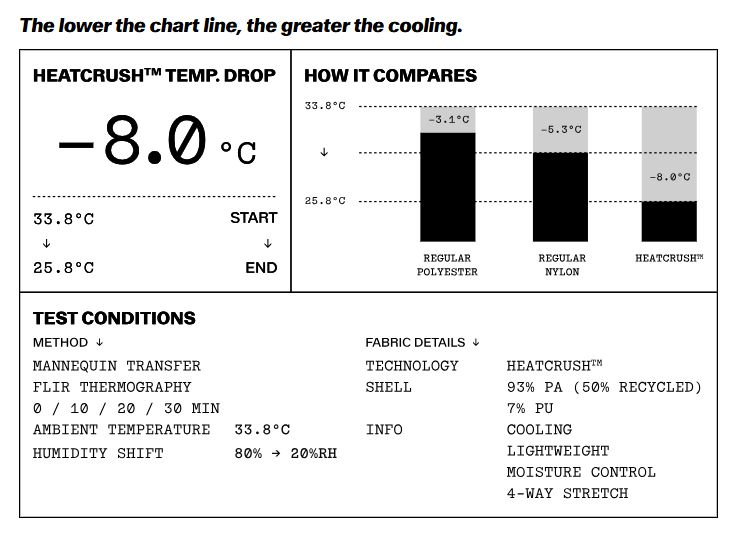
Data from Satisfy on HeatCrush fabric.
From a 33.8 degree baseline, HeatCrush dropped 8 degrees in thirty minutes, down to 25.8. Regular nylon dropped 5.3. Regular polyester dropped 3.1.
That’s the polyamide versus polyester thing from earlier, backed up with real numbers. Nylon nearly doubles polyester on cooling.
The Nike shirt is the other one, and if you’ve been online at all this summer you’ve seen it everywhere. The ACG Radical AirFlow NXT is a long-sleeve trail top that looks like it lost a fight with an industrial hole punch but the thing is, the holes are the technology. Funnel-shaped and tiered with dimpling on the inside, engineered around the Venturi effect so air speeds up as it passes through and gets pushed onto skin instead of just drifting by. Elbows and armpits are cut fully open. Recycled yarns, hydrophilic chemistry. It was all the craze.
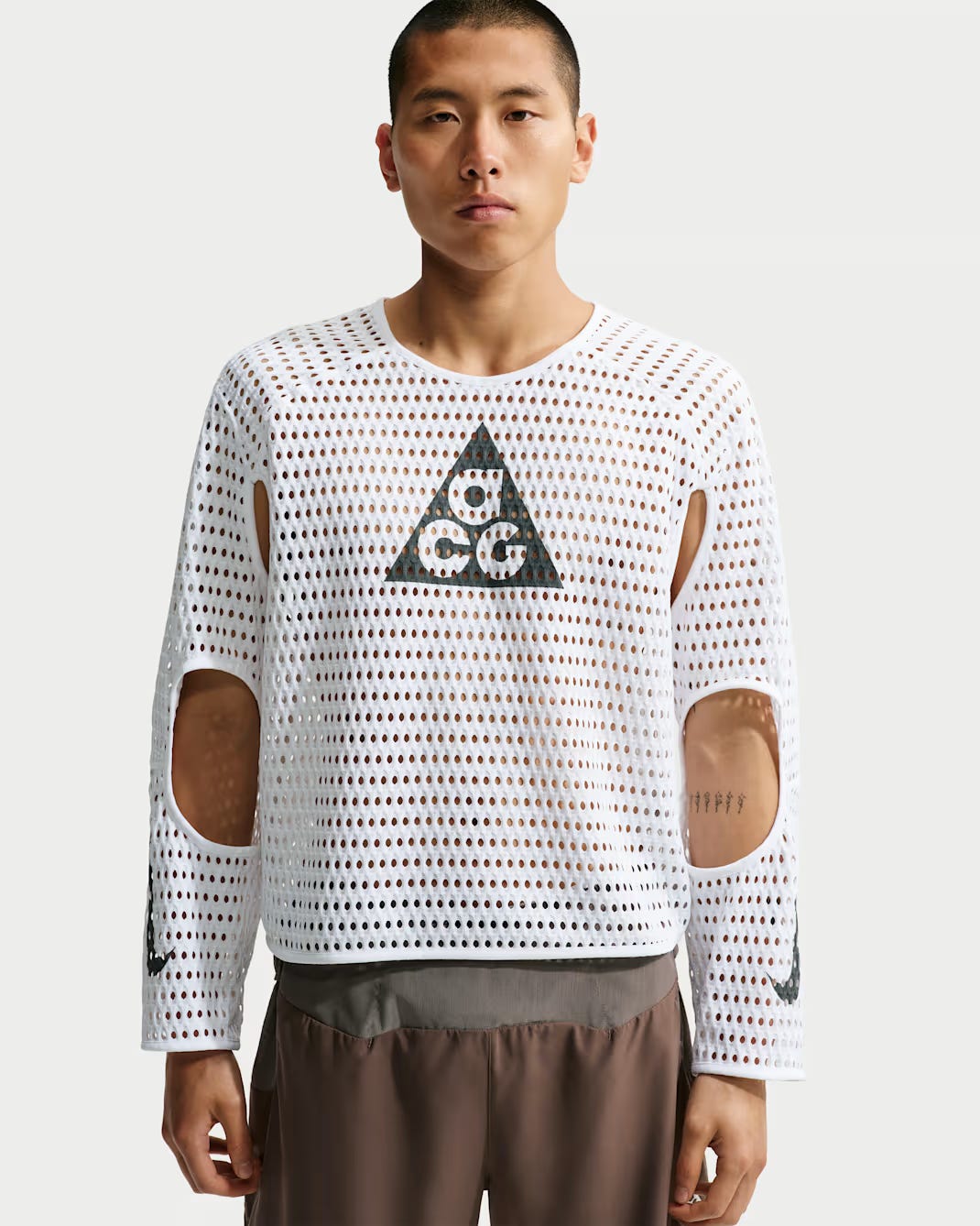
Nike Radical Airflow shirt.
Caleb Olson wore it to within two minutes of the Western States course record on a hot day, in a race with temperatures over 35°C in the canyons. He described it as feeling "like stepping into a fridge," and said once it got wet, that cooling feeling just kept extending.
What's kinda funny is the timeline on all of this. Back in January 2025 Nike put out a hole-punched running shirt that looked a great deal like Satisfy's MothTech. Satisfy called them out real quick, they called it lazy, and pointed out that copying them was really just Nike admitting they'd shifted the conversation. Radical AirFlow is Nike coming back a year later with something they can actually own, proof that even a brand with infinite resources needed a smaller player to shame them into doing it properly.
The Venturi effect is a different piece of fluid dynamics than the boundary-layer tripping in aero fabric, but it’s the same category of thinking, using airflow behaviour deliberately instead of just hoping a mesh panel would do the job. Cycling’s been doing that kind of engineering for fifty years. Instead of directing air toward the body to cool you down, they worked air away from the body to make you more aero.
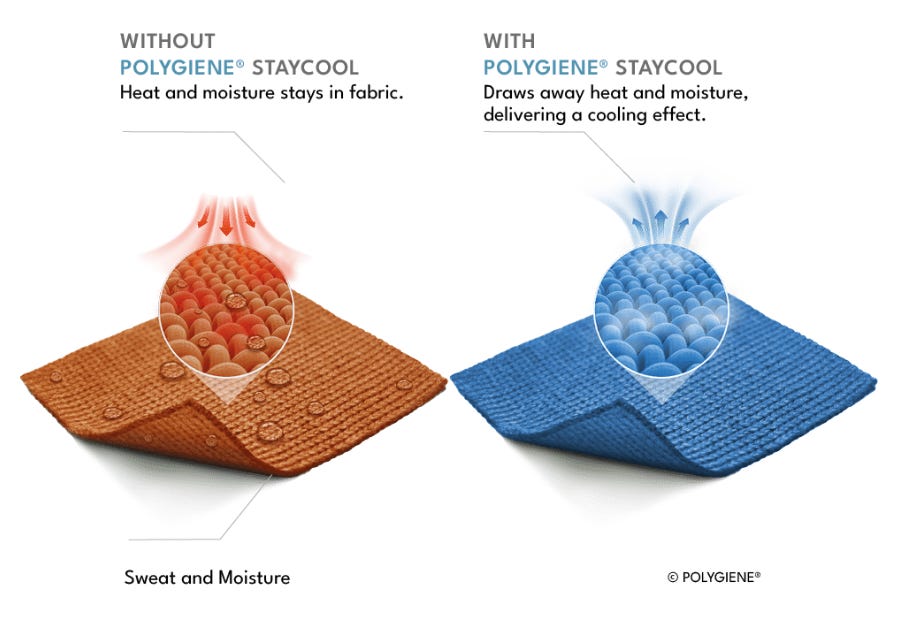
Polygiene StayCool is the third one, and it’s a treatment rather than a fabric on its own. Launched at Performance Days in Munich, it bonds a thermo-reactive polymer straight into the fibre during manufacturing rather than spraying it on afterward, so it sits inert until heat and moisture trigger it, then drops fabric temperature by 2 to 3 degrees. Improves wicking at the same time. Works with cotton, synthetics and recycled textiles.
It’s been buyable for over a year and it’s in some sportswear already. It’s just not in cycling at all.
WATTS
This part will sound a little crazy to us non pro's but it's still very relevant data. At 40km/hr on flat ground, drag is roughly 90 percent of everything holding you back, and 70% to 80% of that is you, not the bike, which means you don't need a new bike. Your clothes (and your position) are doing more aerodynamic work than your frame, your wheels, and your bars put together.
Fabric creates two kinds of drag. Pressure drag is the turbulent wake behind you, where air separates off your body. Skin friction drag is just air scraping across the surface as you move. It took the brands decades to figure out that smooth isn’t always faster.
Think of a golf ball. A smooth one looks faster, right? Well, it's not. Air flows over it clean and then just peels away early, leaving a big pocket of turbulence dragging behind the ball like a parachute. Dimple that surface instead and something weird happens, the air actually sticks to the ball longer before it lets go, which shrinks that drag pocket way down. Less drag, more distance. Those textured panels on your jersey sleeve are doing the exact same trick.
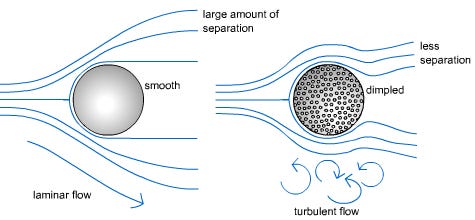
smooth vs dimpled golf ball
Researchers at NTNU, the Norwegian University of Science and Technology, measured 8 watts saved from optimized jersey fabric alone, another 5 from the bibs, at 50km/hr. Dan Bigham, who held the Hour Record before Ganna took it off him, claims a properly fitted aero jersey saves you 5 to 15 watts over something badly fitted. Rule 28 tested their base layer under a smooth skinsuit and got 2.8 watts head-on, 7.5 at 5 degrees of yaw, at 45kph. Now obviously these kinds of watts saved don’t affect me or you day to day, but it’s still watts saved.
Deep-section wheels are worth about 5 watts. Tucking your chin is worth 10 to 15. So the guy who dropped 3 grand on some Scope Artech wheels and rolled up in an ill-fitting jersey basically has his priorities backwards.
WHERE IT ALL COLLIDES
Cycling still hasn’t cracked heat the way it’s cracked drag. Running has already shown what’s possible, sweat-reactive fabric, engineered airflow, cooling built into the weave instead of stuffed down the back of a jersey. Cycling brands need to get there too.
Because right now the cost of not solving it gets passed straight to the rider. If a fabric only fights one of the four problems well, you end up buying separate pieces to cover everything. One kit to go really fast (aero), another base layer for heat, gloves for one thing, foot warmers for another. Every extra product is another cost and a higher barrier to just getting into this sport properly. A brand that actually solves heat the way it's solved drag isn't just making a better product. It's saving you from having to buy four different products to do one job.
Part two gets into the stuff actually touching your skin. The chamois nobody thinks about until it's wrong. The brands already building smarter fabric into real kit right now. And the ones outside cycling entirely who are doing things with fabric the sport hasn't even thought to ask for yet.
To submit a site, product, or whatever you’re working on, email KMC@GRAVITYHILL.CC. We read everything. Posting is never guaranteed, but curiosity always is.
Really interesting, some of your best work yet!