


The BREAKAWAY is for getting off the wheel. Longer thoughts on cycling, culture, and taste. Less reaction. More distance.
You can follow us on Instagram here but in its purest and most beautiful form this is a newsletter, something to slow your timeline down.
Picture the Giro in the 1940s. Or the TDF. Whatever old school bike race your brain wants to imagine. Somewhere in that timeline, there’s a rider sitting on the edge of a hotel bed rubbing cream into a piece of leather. That leather (the chamois) is stitched into his wool shorts, and if he doesn’t soften that thing before the stage, it’s going to crack and tear his skin apart somewhere around kilometre 120 (or sooner…probably sooner).
Now look at what you wear on your rides. You’ve probably spent real time thinking about the kit. How it looks. The colours, the fit, whether the socks match (kitmaxxing is a condition, and if you’re a sub of mine, then you definitely have it). But what about the pad in your bibs? You usually only think about it when it starts to cause problems. Is it the pad? Is it a seam? Are your shorts not tight enough? Is it the saddle?
Part one was about why cycling fabric chases watts while running chases temperature control. Part two is a little different. It’s about what actually touches your skin, from the chammy to the fabric, who really made it, and what to look for when buying a great pair of bibs.
WHO MADE YOUR PAD
As a trend in cycling apparel, the leather chammy lasted decades. Which might have been a little too long, tbh. Their asses must have felt like a baseball mitt (sorry for the imagery). Anyways… Around 1980, there was finally some innovation. A Japanese company launched a microfibre “pad” called Amaretta, and it was so close to buckskin that the only giveaway was the smell (it just didn’t smell like leather, which, obviously). In 1991, De Marchi patented a heat-moulded microfibre pad. The new age chammy was slowly evolving. The real leap though, the one in your bibs right now, the one that got me asking questions, came around the year 2000, when the pad learned to stretch. It moved with you instead of fighting you.
So who pulled that off? A company called CyTech, which started life as a De Marchi division. The actual brand name is Elastic Interface, and two cousins who worked at De Marchi, Marino De Marchi and Stefano Coccia, founded it around the year 2000. CyTech sold over 3.2 million pads in 2020 and sells in more than 40 countries, and De Marchi’s own blog says Elastic Interface is now widely licensed across many quality cycling brands. So there’s a good chance the chamois in your bibs, regardless of whose name is on the label, came from them. From what I’ve dug up, that kind of white labelling is common across cycling. The pad, the fabric, a lot of it. Most of it, really.
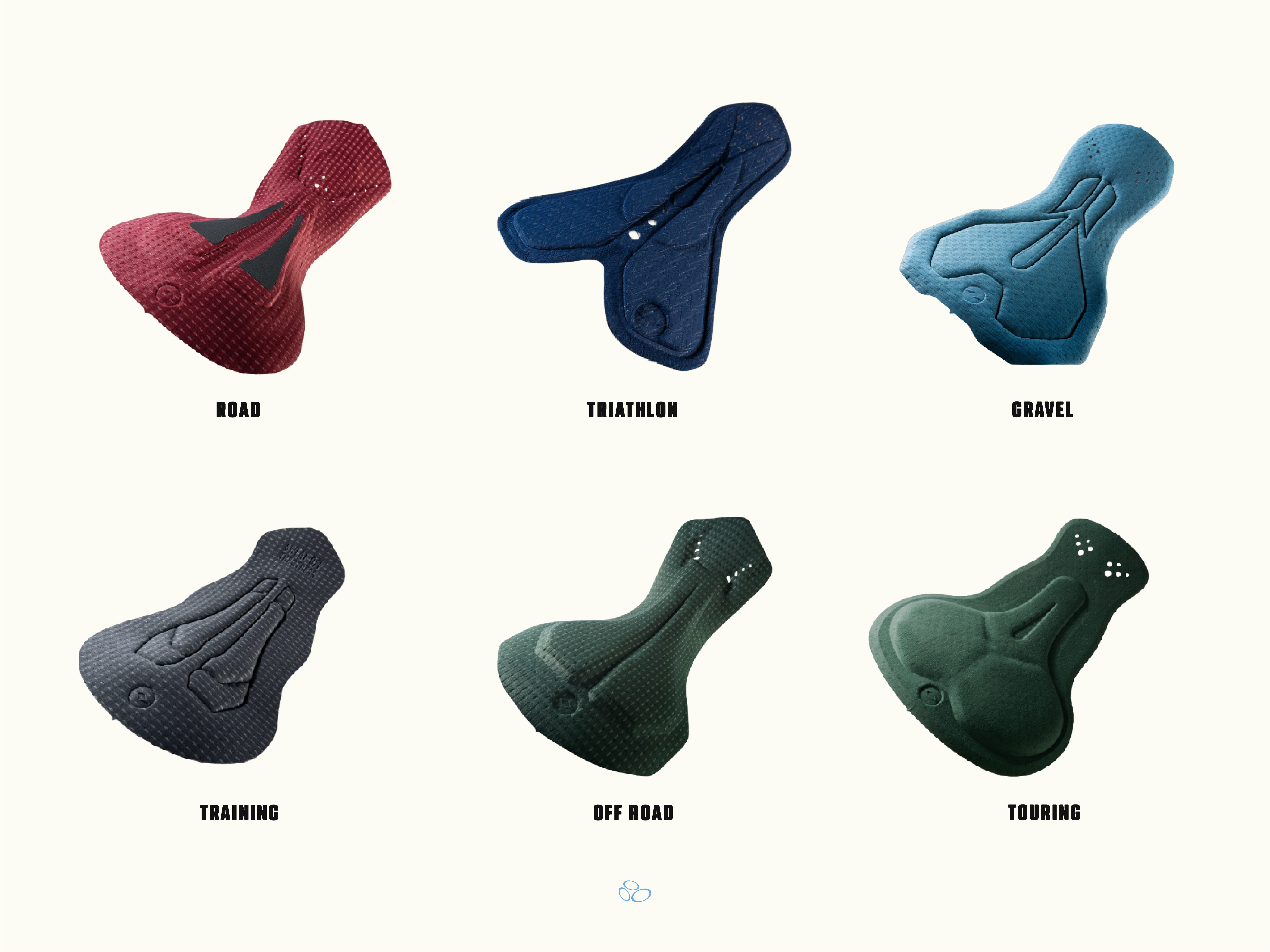
The Different Elastic Interface pads.
Now when it comes to bibs, everyone knows Assos makes some of the best in the game. Anybody who has the (deep) pockets to buy a pair will try to convert you to the holy church of Assos. Style wise, they’ve always felt bland, so I never paid much attention. Then again, bibs don’t need to be fashionable. They need to work. And everyone on my group rides has been preaching it all summer, so consider me converted (pray for my wallet). I really wanted to understand why Assos bibs are so good, so I tested my luck and went straight to the source. One of my subs (thanks Ollie!) put me in touch with Luca, Head of Product Development at Assos.
I asked him what people get wrong about the chamois. He started with how brands talk about them. “Most communication around chamois design stays very generic,” he said. “It never really goes into detail.” When’s the last time a brand told you what’s actually inside yours? Or why they selected said chammy and placed it that way (some chammies sit in the bib differently than others.)
ASSOS started talking to CyTech in 2001, and the relationship isn’t a normal supplier deal. It’s exclusive. “The design and materials are exclusive to ASSOS,” Luca said. “The design and construction of the chamois start directly from ASSOS. What CyTech does, starting from our input, is find the best possible compromise in terms of materials and processing.” ASSOS designs it. CyTech figures out how to build it.
So the name on the bibs says ASSOS, but the company that engineered the pad inside is one most riders couldn’t name (unless you geek out about this stuff). That’s the whole thesis here, and it’s what the rest of this article is about. The name on your kit isn’t always the one that made it.
Not everything in there is CyTech’s though. ASSOS has its own patent for how it’s sewn to the actual bib, and they call it “Golden Gate” (a little weird of a name for something that’s so close to your genitals, but alas, here we are). This patent is probably as important for comfort as the pad itself. The chamois is stitched down only at the front and back (hence the bridge reference), then left free everywhere else. We’re never 100% stable on the saddle (we wobble, we shift, we stand up at the lights), so the pad underneath us shouldn’t be either. It follows your body instead of following its own path.
ASSOS’s long-distance bib is the Mille GTO, and the pad inside it is called the S11. It’s 21 millimetres total, but that number is somewhat irrelevant because it’s two completely different foams stacked together. An 11mm layer for support, and a 10mm layer of much lower density for breathability (FYI, this pad takes a long time to dry post wash, so plan ahead cause the dryer ain’t an option). Pad height on its own is a marketing number. What really is important is foam density. Always take dense foam over thick padding. You’ll be thankful.
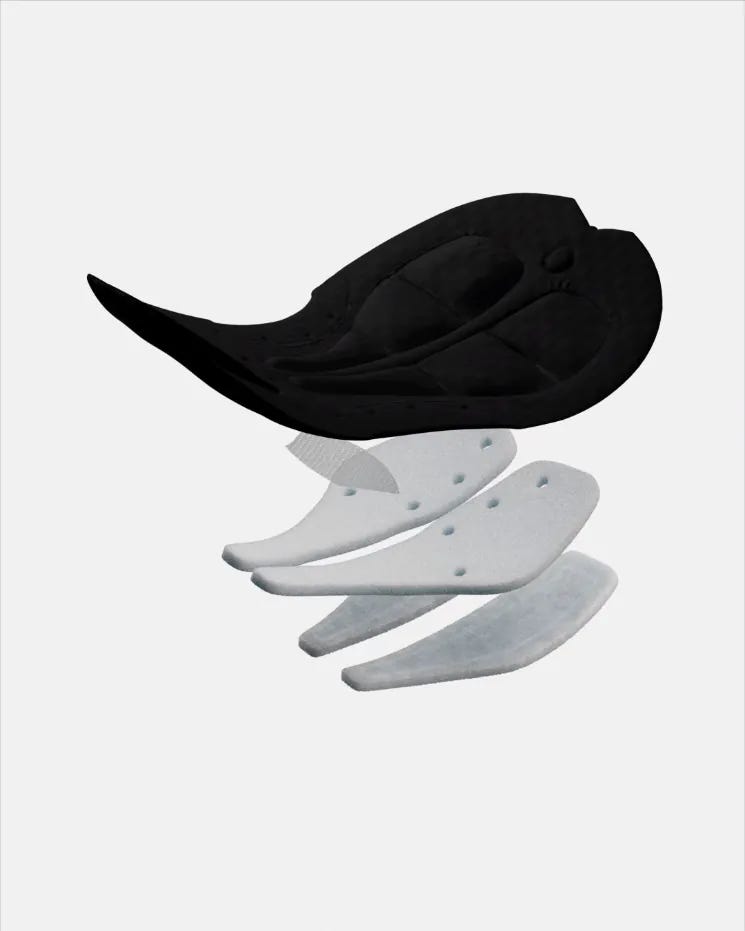
ASSOS GTO S11 pad
Out of curiosity, I also asked Luca if there was a material from a completely different industry he wished existed in a chamois. Something weird, something different. “Yes, but I can’t share it right now.” I’m choosing to read that as “something’s coming.”
THE MILLS NOBODY PUTS ON A JERSEY
Here’s something I only recently found out, and it changed how I view some brands. The pad isn’t the only place where white labelling happens. Plenty of brands, maybe most, don’t invent new fabrics, even when they say they do. They buy from a mill, order just enough meters that the mill lets them rename it, and market it as their own. Proof? I don’t have any tbh. It’s what I’ve picked up from a few convos I’ve had lately with designers at pro teams, and none of them wanted to go on record (shocking…). So you’ll just have to take my word for it.
That means the real invention happens somewhere in the “shadows”. The mills rarely get their name on a jersey, and a lot of the time they’re the ones doing the work. I find that odd about cycling because if you look at (hashtag) menswear, suiting brands will tell you exactly where the cloth comes from, and they’re proud of it. It’s a flex. Cycling should flex too. Fabric mills are super dope and they should be recognized way more than they currently are.
Polartec is the mill that breaks that pattern though, and it does it on purpose. They invented fleece in the 1980s, they make over 400 different fabrics, and their name travels with the fabric. That’s the deal. One of their sales agents put it plainly: “Polartec works on licensing agreements, so to be able to become a customer we will have to license the brand.” If you want the fabric, you take the name too. Rapha, Castelli, Santini, Sportful and Mavic have all done it. And it shows. Most technical kit (cycling or other) I’ve looked at that’s made with Polartec says so right in the specs.
It isn’t just a fabric order either. Polartec says it starts with one-to-one meetings while the brand is still developing the product, then continues from technical support through design. The fabric is Polartec’s. The jersey, the cut, the panels, the wind tunnel testing all belong to the brand. That matters when you’re shopping. Two brands can both say Polartec Power Dry and still hand you very different jerseys, because the fabric is only the ingredient, not the final dish.
Most mills aren’t Polartec, though. Take MOA Sport for example, the factory behind Nalini which was created by the Mantovani brothers, Vincenzo and Claudio. Nalini is the name on the jersey. MOA is the building near Verona where a lot of it gets made, along with a lot of other brands’ stuff. It’s been written for years that the kit from MOA “is often marketed as Nalini or under another brand’s insignia,” and that Rapha was one of many brands that used it for their team gear. Charles Manantan toured the factory in 2018 and put it better than I could: “Many companies tell you ‘who’s fabric’ they use… Not many can make their own fabric weaves and blends to their own internal specification.” MOA can. It makes a lot of its own chamois pads in house, and its socks start from single fibres too.
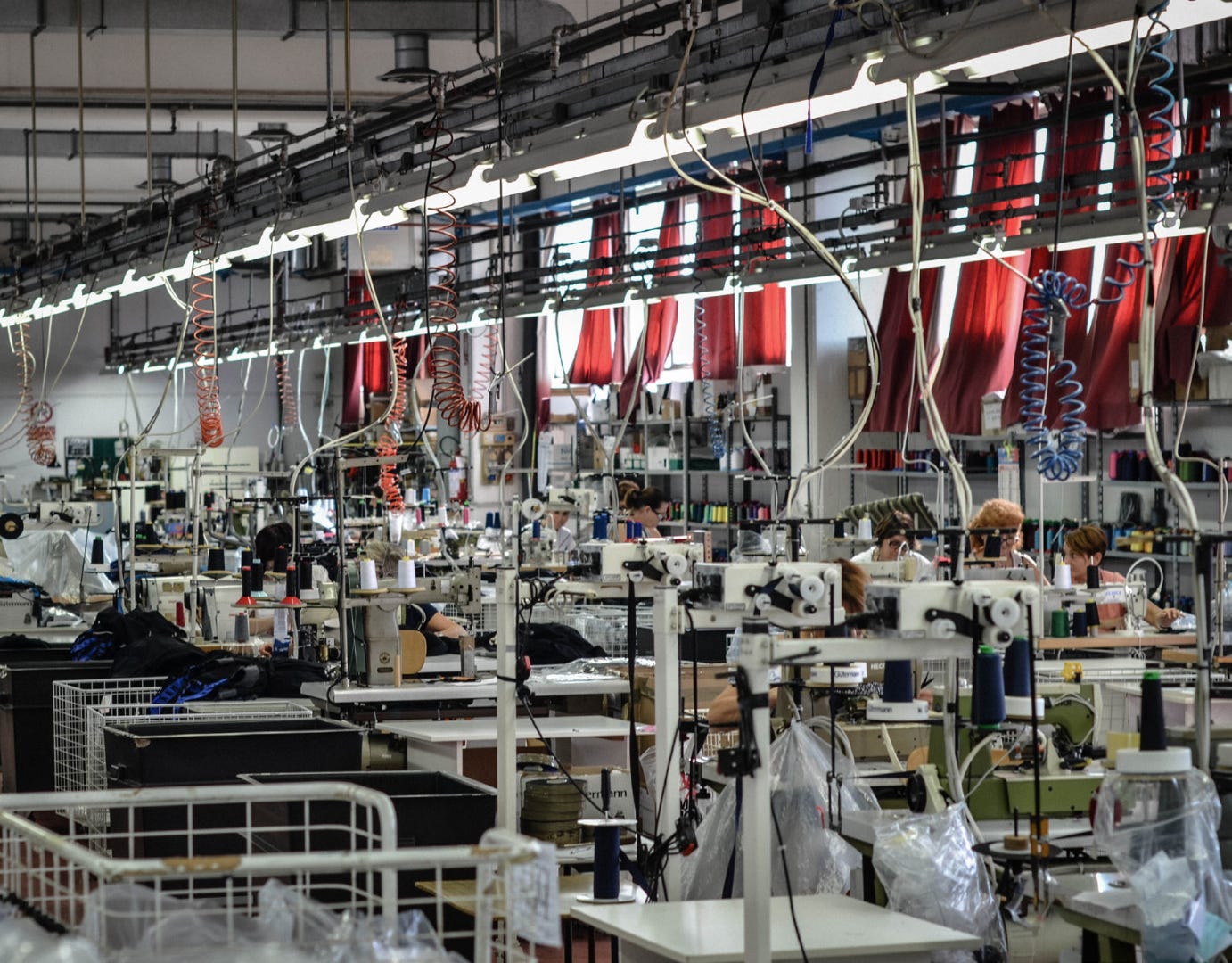
MOA Sport Production Line
Considered alongside the pad and you’ve got two stories about the same jersey. The brand’s story: a new fabric, a new name, a launch video with some slow motion, or whatever. The factory’s story: the weaves, the machines, the people who know how to run them. More often than you’d think, the company that says it created the fabric and the company that actually manufactured it are two different companies. I’d love to see more brands close that gap.
Even from inside ASSOS, Luca told me the materials aren’t the secret. More or less every competitor, brand or chamois maker, has access to the same new fabrics. “The real difference is how you use them, and in what way.”
To be fair, buying from a mill isn’t cheating. Most good kits start that way. Most fashion brands in the world starts that way. Hit up the fabric trade shows, pick fabric, make stuff. Picking the right fabric and tuning it takes real skill. The problem is the story on top, the one where the brand takes the credit and the mill vanishes.
WHERE BRANDS ACTUALLY INNOVATE
Some brands do the work, and you can tell, because you can point to it. A pad. A knit. A yarn.
Castelli buys from mills too (hello Polartec), but it’s the type of brand that keeps innovating with its own ideas. In the late 90s they built the Progetto Y pad, which they say revolutionized the chamois. Later came the Aero Race jersey. By 2013, Castelli was claiming the 4.0 saved about 12 watts at 40kph over a normal race-fit jersey, and a year later it said the 5.0 saved 20, back when most of the sport treated a jersey like a costume with a sponsor on it instead of actual performance equipment. Then Nano Flex, a five-phase treatment that Castelli says makes water bead up and roll off, while staying as warm and breathable as their regular Thermoflex when it’s dry. A coating on the fabric, not a membrane. And let’s not forget the Gabba, a piece of garm’ so good that pros on other teams started buying their own and blacking out the logos. Four different ideas from one brand.
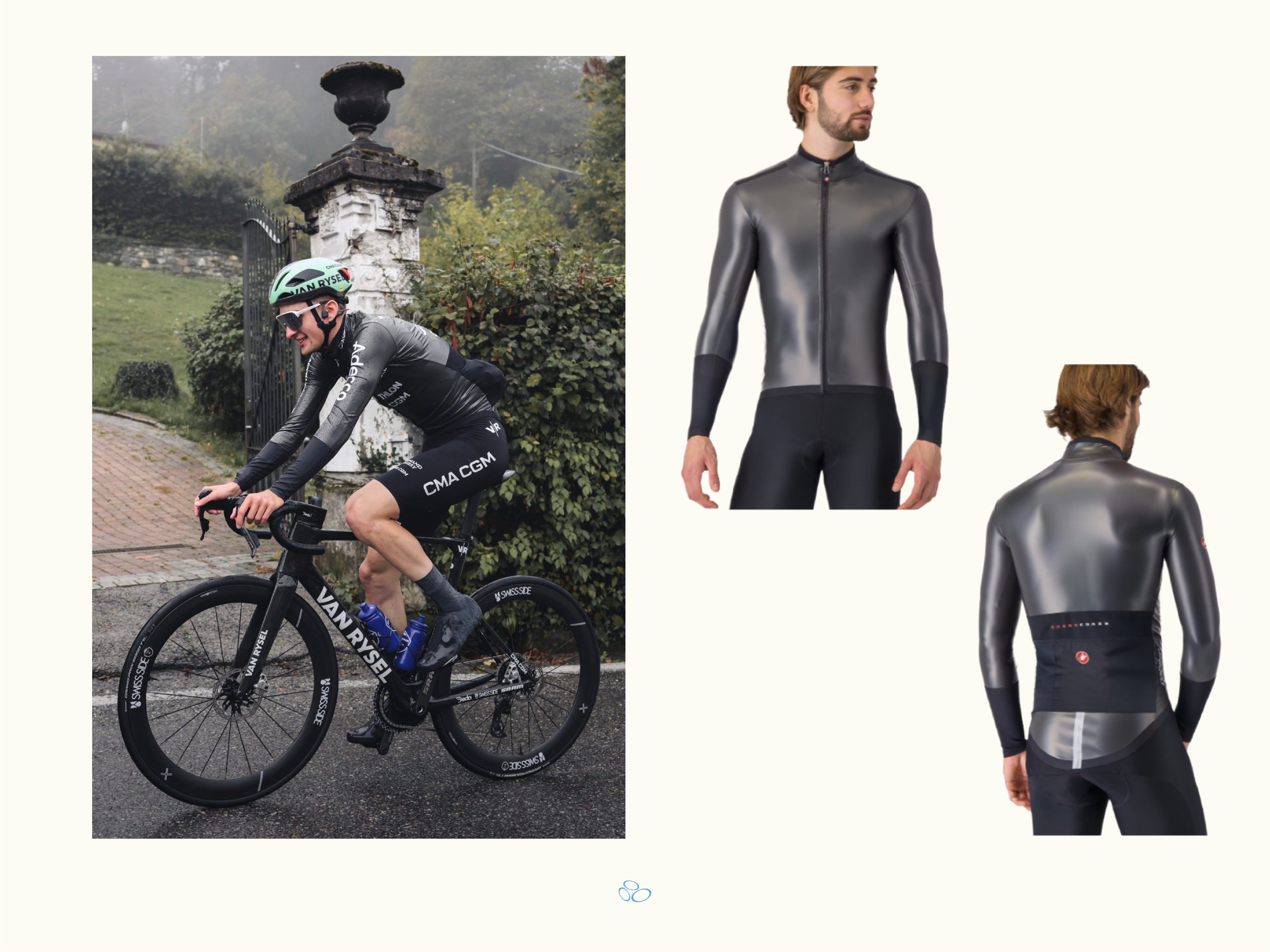
Paul Seixas wearing a Decathlon-sponsored Gabba.
Attaquer didn’t build a new fabric. They built a new way to make the jersey, which is a different kind of idea, and the cleanest answer to everything I just said about renaming mill fabric. Attaquer says OrbKnit is knitted in a circular pattern, like a spider’s web, on Italian circular knitting machines, so the structure can change across a single piece. Mesh sections are placed using sweat-rate mapping, compression zones are built in, and it’s all woven into a single fabric. Barely any seams.
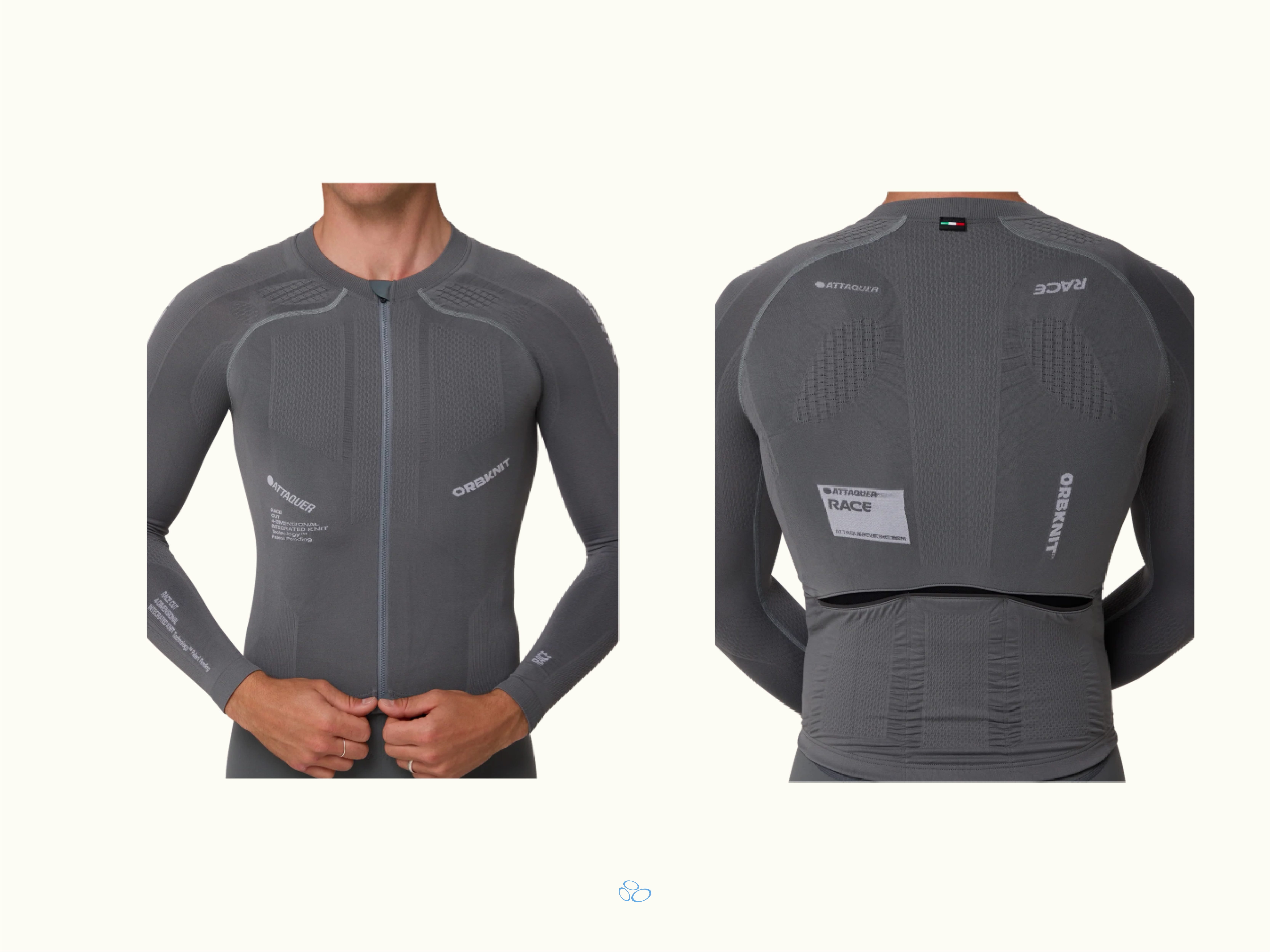
Attaquer OrbKnit jersey
I mentioned Q36.5 in part one, but they deserve a second look. The Dottore Clima line weaves graphene yarn into the fabric itself, not as a coating. It’s Q36.5’s own yarn technology. Q36.5 says graphene conducts and dissipates heat, so the fabric does some of the thermoregulation instead of leaning on evaporation like a normal jersey (that’s the brand’s claim, not a test result). A cycling brand is putting graphene into a jersey you can buy today. We need more of this.
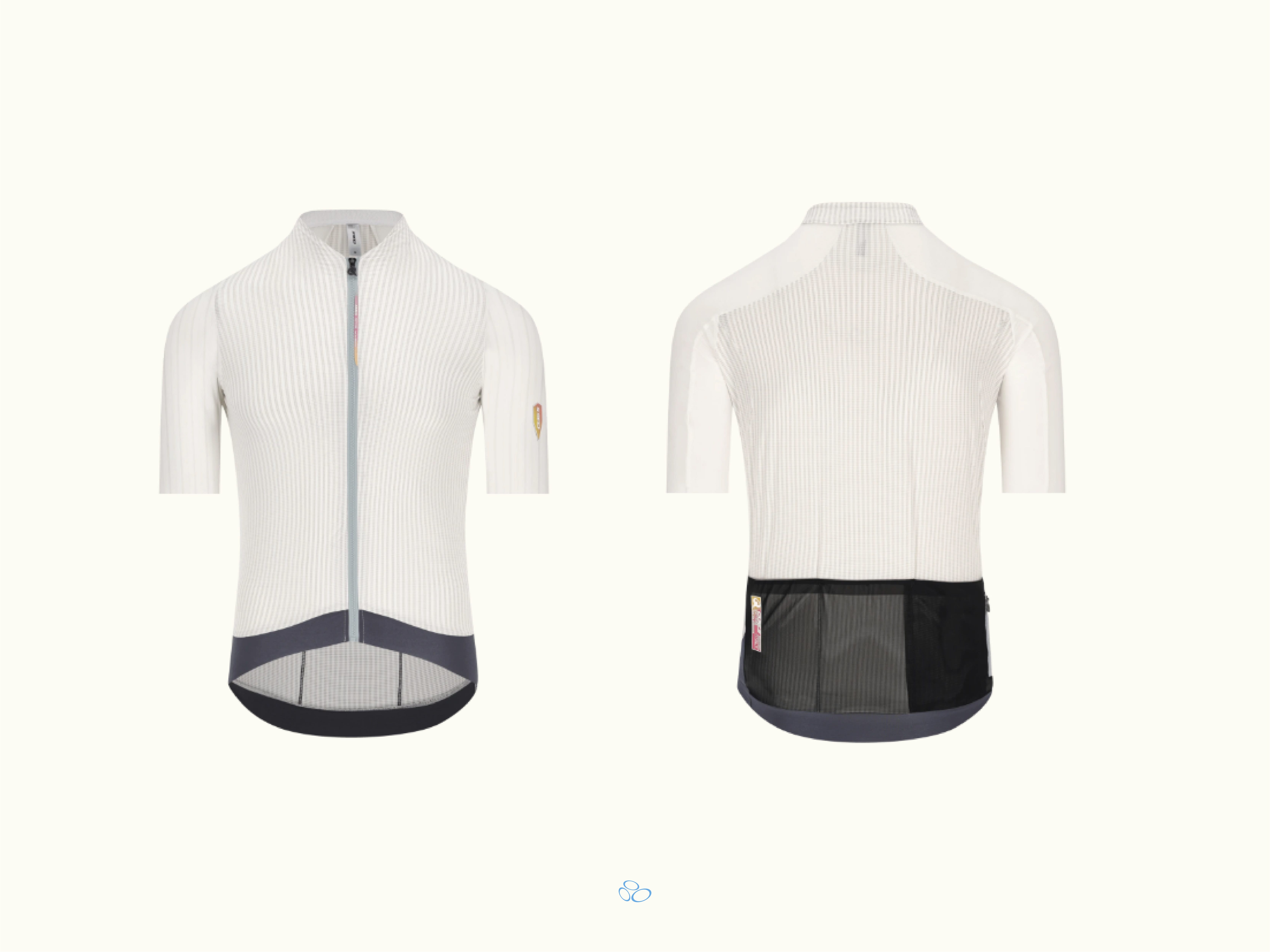
Q36.5 Dottore Clima jersey
Assos has been mentioned a million times already, but their kit deserves a shoutout as well. AirCell is Assos’s proprietary ultralight circular knit with an open hexagon structure. AirBlock-EVO.888 is a three-layer softshell. “Proprietary” sounds like a marketing term, so I asked Luca what it means when Assos says it engineered a fabric with a supplier. When they develop a new fabric, he told me, they start from a brief: weight, breathability, stretch and price point. Then they work with the supplier to manufacture it. So the supplier isn’t just handing over a fabric, and Assos isn’t inventing one alone. It’s a collaboration.
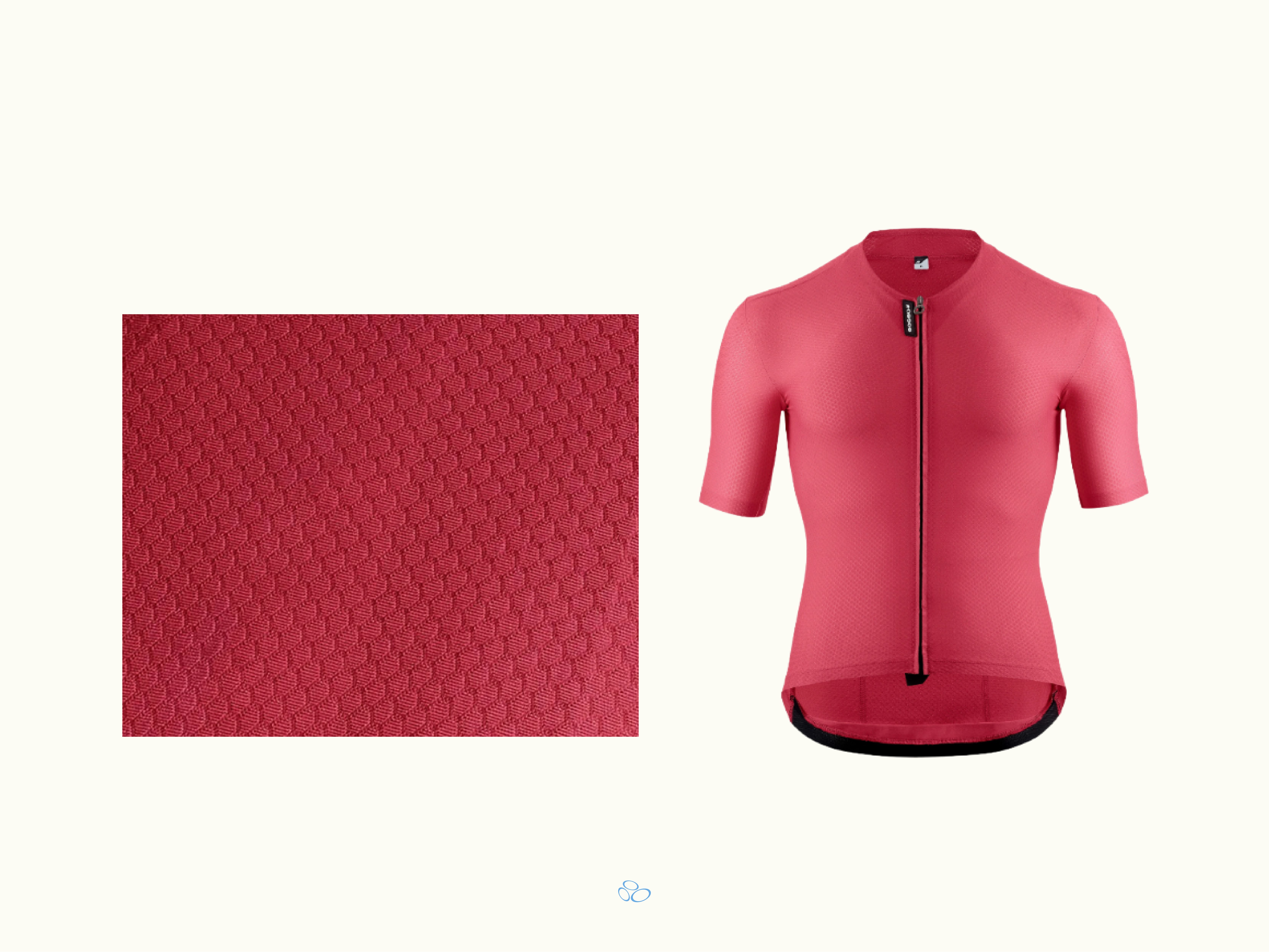
ASSOS AirCell hexagon knit
HOW TO BUY GOOD BIBS
Everything above is only useful if it changes what you put in your cart. Here’s a small checklist that focuses on quality, and not style (that’s for a later article).
Read the tag. You want a maximum of 15 to 20% of Elastane. The rest should be polyamide in the good bibs. If you want cheaper bibs, go with polyester. Polyamide costs more and wears longer.
Find the weight. If the GSM is listed, check it against the season you’re buying for. Lower GSM for warmer seasons, higher GSM for colder seasons. If it isn’t, hold the fabric up to a light. A summer jersey should be somewhat transparent.
Judge the pad by density, not thickness. We’d take dense foam over thick padding every time. Look for layers of different densities with ventilation holes and a thinner central channel to take pressure off. Endurance pads are thicker with more cushion at the back, race pads more at the front (aerotuck baby!). Then flip the bibs over and look for the pad maker’s name. Not a problem if it isn’t there, but if it is, it usually means quality.
Check the straps and grippers. Straps should lie flat and not dig in. Wide grippers beat narrow ones. And the best grippers aren’t a separate band sewn onto the leg. They’re silicone grippers applied straight onto a cleanly cut edge, like the leg ending on Castelli’s Espresso bibs. That’s one less seam against your thigh and one less thing that can irritate.
Everything should fit like a second skin. Tight tight tight. No saggy spots, nothing that restricts your range of motion. And remember the pad and the shorts are a pair. Luca told me different shorts fabrics stretch differently, and “once the shorts are worn, the chamois sits differently on the body.” That’s why the same pad can feel different from one bib to the next. Try the whole bib, not the spec sheet. Loose clothing causes chafing. Tight stuff shouldn’t.
Look at the seams and how it’s put together. MOA’s production page describes laser cutting for clean edges, ultrasonic bonding that joins materials with high-frequency sound waves instead of needle, thread or glue, and seam-free construction that adapts to the curves of the body. Their claim is lighter garments with “imperceptible seams” and a “reduced risk of skin irritation.” That’s what I’d shop for first. A stitched seam is a ridge against your skin for six hours, and a bonded one isn’t. MOA doesn’t publish a stat for producing this way though, so call it MOA’s claim and my preference, not a test result. Overall, you want fewer seams.
Read the product page like a skeptic. You can’t call the brand, but you can read what it gives you. Look for specifics: a named fabric, a named pad maker, a GSM, a percentage, a test. Be wary of adjectives with nothing behind them (”proprietary” is the classic). A number beats an adjective, like the thermal mannequin test Satisfy ran in part one. And if a page can’t tell you what’s actually different about the kit, that’s your answer.
Know what the money buys. The cheaper stuff won’t last. The better stuff will. More money usually buys better fit, straps, grippers and pad, with diminishing returns after a point.
Next group ride, look around. Count the logos in the bunch, then think, just for a second, which of those brands are actually doing something “innovative.” Same goes for the next new-product email from (insert any cycling brand here). Notice the wording.
As much as I love kit design, we seem to forget that we don’t need as much kit as we think we do. But I know, and you know, we’ll probably keep buying it all anyway…
To submit a site, product, or whatever you’re working on, email KMC@GRAVITYHILL.CC. We read everything. Posting is never guaranteed, but curiosity always is.