


FEED ZONE is for the scroll. Kit, objects, rare finds, and things worth stopping for. On the bike and off it. In and out.
You can follow us on Instagram here, but in its purest and most beautiful form this is a newsletter, something to slow your timeline down

Before we get into it
GRAVITYHILL is free to read and will be for a long time. But if you are getting something out of it, a subscription goes a long way toward keeping this independent. Even a share.
In case you missed it, here is what we have been working on:
BREAKAWAY // 005 — Cycling Has a Visibility Problem
Ben Healy has 105,000 followers. Lewis Hamilton has over 40 million. That gap is not about talent. How fashion became the entry point for every sport that cracked the culture problem — and why cycling has not run that playbook yet.
LEFT TURNS // 003 — What If Cycling Had a Creative Director?
Crystal Palace did it. Como 1907 did it. The Cleveland Cavaliers did it. Every sport with cultural ambitions figured this out already. What happens when cycling finally makes the call.
BREAKAWAY // 004 — The Kids from Piazza San Babila
Milan, 1983. A generation decided the most radical thing they could do was refuse politics entirely. No manifesto. Just dress better than everyone else. What the Paninari understood about clothes as ideology, and why cyclists have been running the same logic ever since.
If that sounds like your kind of newsletter, you know what to do.
We do not use affiliate links. We do not get paid to feature anything. No sponsored placements, no brand arrangements, no performance fees. Just things we actually rate. For the love of the game.
THE WHITE SOCK EDIT
We know the white sock rule sounds a little stuck-up. It is but we don’t care.
For the record, we wear white socks off the bike ninety-nine percent of the time. This is not a cycling thing. It is just a sock thing. We are a little obsessed with a good sock. This article was kinda inevitable…
So lets start here. Fausto Coppi, 1952 Tour de France, yellow jersey, white socks. Eddy Merckx, every race he ever entered, white socks. Anquetil. Hinault. Lemond. Bernard. The entire history of professional cycling, photographed in black and white and then in colour, and the one constant from the velodrome at Roubaix to the summit of Alpe d’Huez is white socks. Not because anyone decided it per se, but because nobody questioned it.
The sock was a utility object for most of the sport’s first century. Cotton, mid-calf, white. It absorbed sweat. It protected the ankle. It cost nothing and said nothing and sat between shoe and skin the way a sock is supposed to. The riders who built the mythology of this sport wore white socks not as a statement but as a default. Which is, paradoxically, what gives them weight now.
Because at some point cycling decided it needed to evolve. Teams got title sponsors. Kits became billboards. The jersey went from wool to lycra and the colours went from national to corporate. And somewhere in that transition the sock got pulled into the rebrand. Compression socks appeared. Coloured socks appeared. The ankle sock appeared, which is its own crime (Vingegaard still rocking these btw…). The sock that had been a blank slate for a hundred years became a canvas.
In professional cycling, almost nothing belongs to the rider. The jersey is the sponsor’s. The shorts are the team’s. The helmet, the shoes, the frame, all of it decided somewhere upstream. The rider is the least free person in the peloton when it comes to what they are wearing.
Except for small things. A necklace. A bracelet under the glove. The cap rolled under the back pocket. And the sock. The sock is the one place where the visual logic of the kit is not entirely dictated. Which means when a rider makes a considered choice about the sock, it reads. Immediately. Silently. The way the right detail always does.
The white sock is the choice that transcends everything else. It does not fight the jersey. It does not compete with the shoe. It does not announce a preference or a brand allegiance. It belongs to nobody and therefore works with everything. Merckx in Molteni orange. Hinault in Renault yellow. Pogacar in UAE white. The sock underneath all of it: the same.
Lance Armstrong wore compression socks so aggressively tall that he had to explain himself to the Tour de France director over lunch. The UCI legislated sock height not long after. Some people are still hating him for that fashion faux pas, and not for the other thing.
The UCI was not entirely wrong. A longer sock reads better than an ankle sock. Visually. And it turns out that modern sock fabric is technically more aerodynamic than bare skin. The longer the sock, the more it works. The UCI measured it in wind tunnels. So the look and the marginal gain are, for once, pointing in exactly the same direction.
Now the part that does not get talked about enough. A white sock has nowhere to hide.
A pattern gives you something to look at. A graphic gives you something to read. A colour story gives context. White gives you nothing except the object itself. The quality of the yarn. The density of the knit. The way the cuff holds its shape across 150km of riding or loses it after forty minutes. The way the white stays white after ten washes or goes grey, then yellow, then unwearable. These are the things white makes visible.
This is the same logic that makes a white Oxford shirt the hardest thing to wear well. No colour to blame. No pattern to hide behind. Just construction. And most socks, when you take the graphic away, have nothing underneath it.
The brands getting white right are the ones who did the extra reading on yarn, on construction, on cut. PROLEN instead of polyester. Seamless instead of seamed. A cuff engineered to sit at a specific height and stay there. A sock built to be white in six months the same way it was white on day one.
That is a different level of commitment to the object. And it is immediately visible on the bike.
White sock, white shoe. That is the rule. Go as wild as you want with everything else. Colour on the kit, colour on the frame. Even colour on the shades. But the sock stays white.
Here are our four favourites right now.
Fingerscrossed #002 Classic White
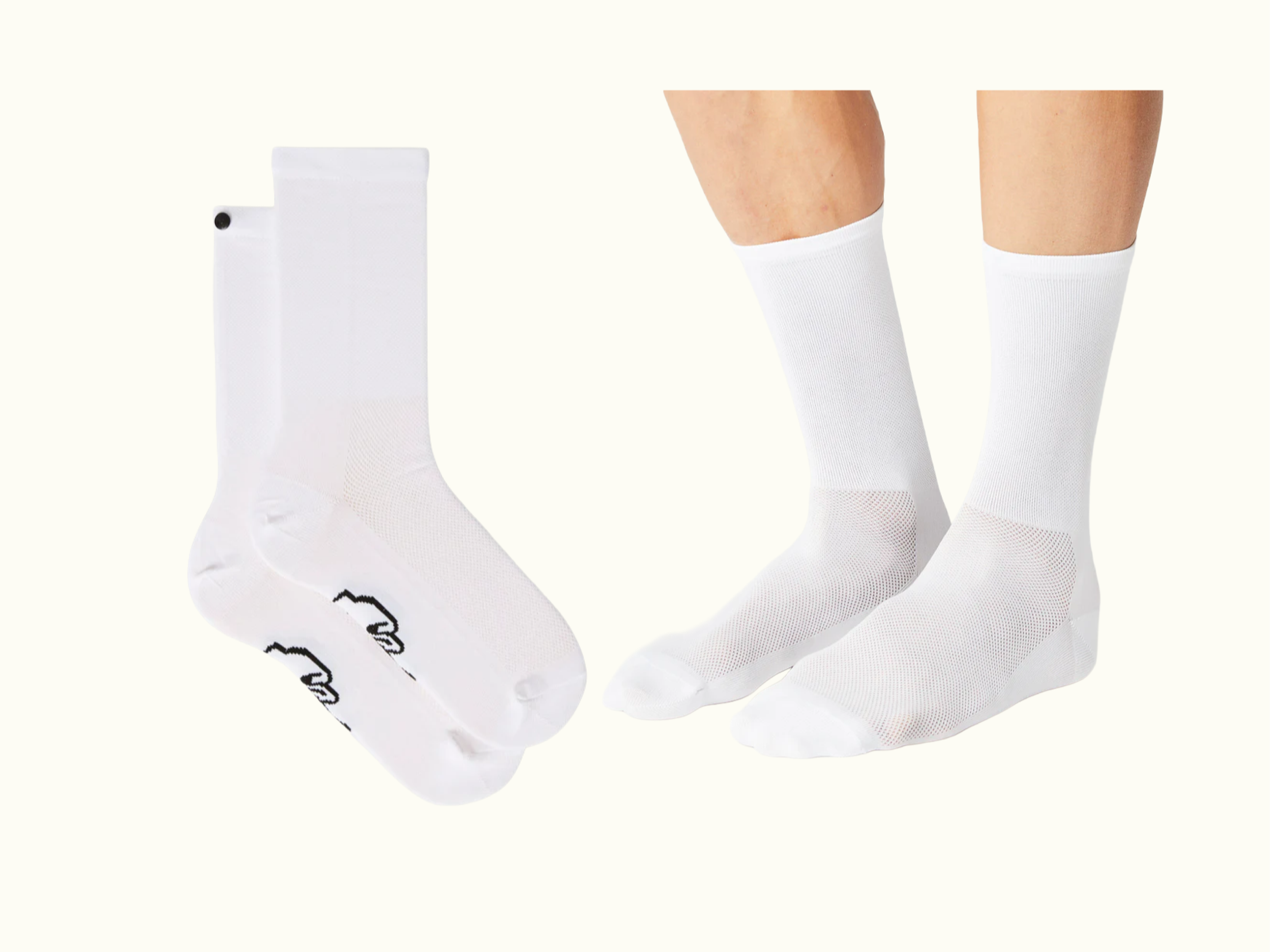
The one that started the brand. Bavarian-made, PROLEN yarn, a hand-pressed nickel-free rivet on the left sock. Not the right. The left. That detail alone tells you everything about how seriously these people take the object. PROLEN is a polypropylene-based yarn, lighter than polyester or nylon, moves moisture faster, dries almost instantly. The brands reaching for it are the ones who did the extra reading. No graphics. No colourway story. Mid-calf cut, sits exactly where it should, stays there across the whole ride. The benchmark everything else gets measured against.
Find here.
Attaquer ULTRA High Crew Sock White
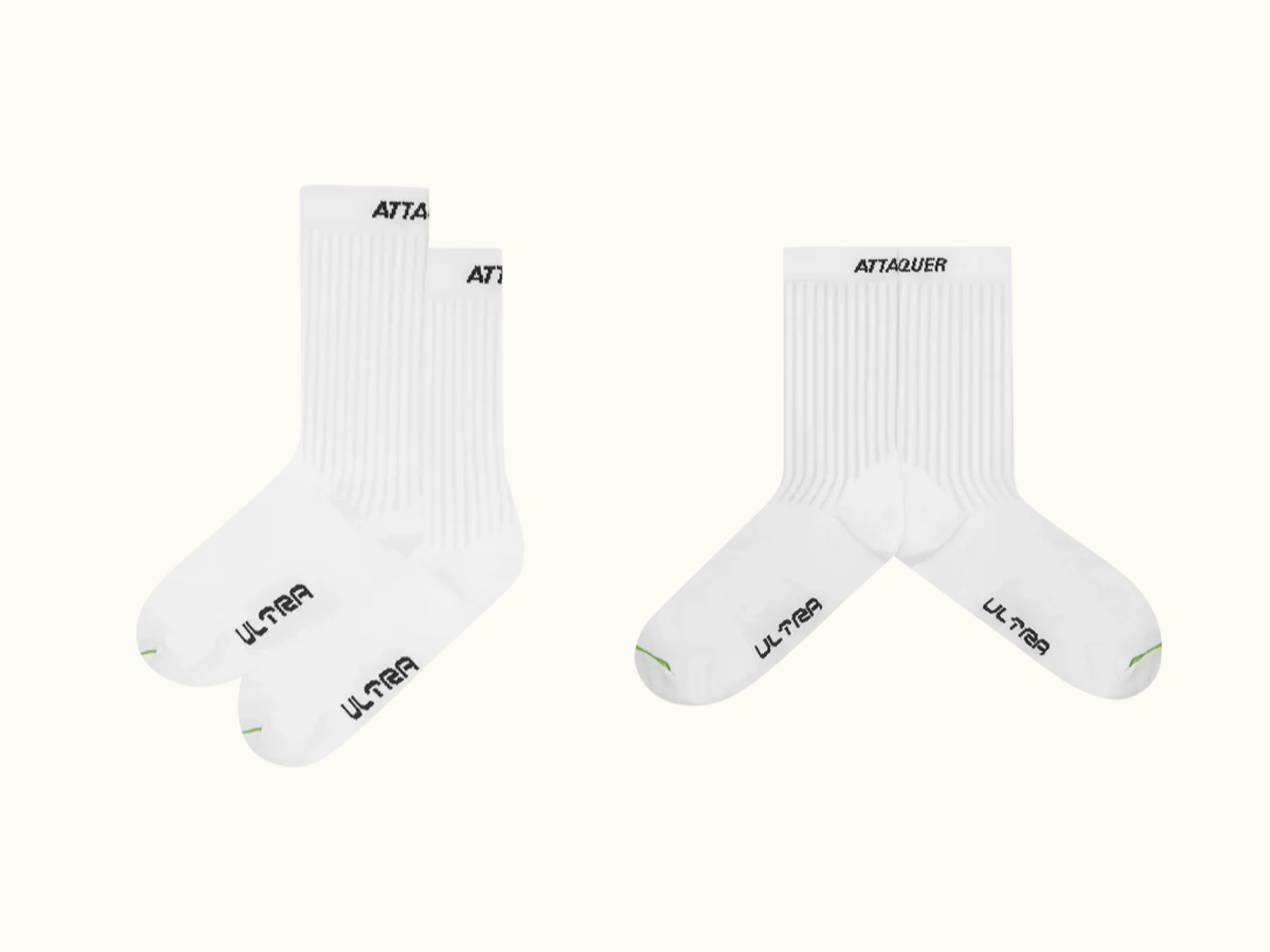
One of the more technically ambitious socks on this list. The yarn is the story. Far Infrared technology absorbs body heat and promotes microcirculation, which sounds like marketing until you read how it works. Silver yarn in the footbed handles antimicrobial protection. 195mm ribbed tube, low pile construction for direct connectivity to the pedal, seamless toe closure. The kind of sock that has clearly been thought about from the inside out. Clean white, high crew cut, sits exactly where it should.
Find here.
nologo Classic White
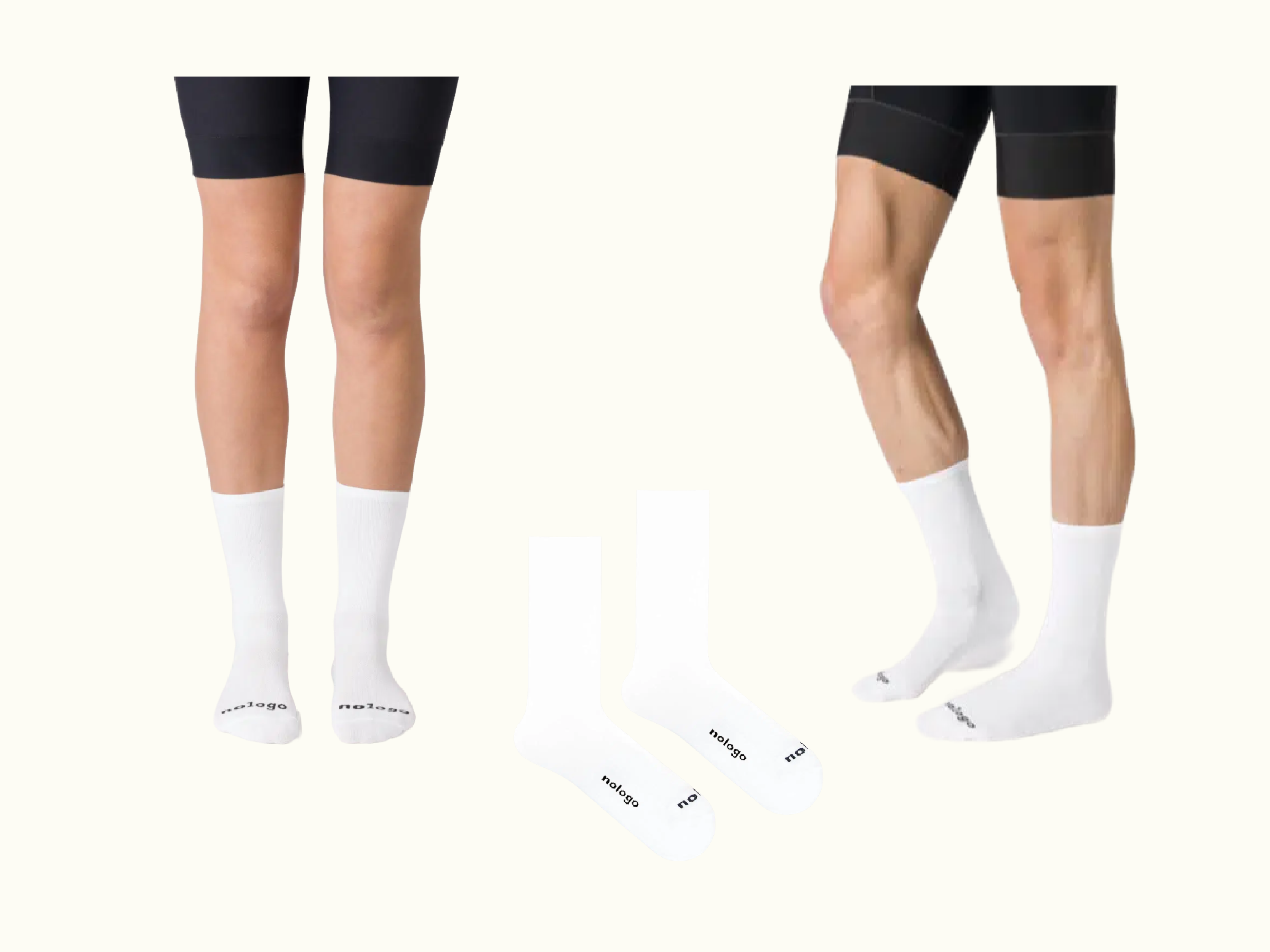
Czech brand. Barely anyone outside of Europe is wearing them and they are not particularly bothered about changing that. Same PROLEN construction as Fingerscrossed, same logic, different postcode. Four cuff height options including a 27cm version that has no business looking as good as it does. The name is the ethos. No logo means the sock has to earn attention on its own terms. It does. Worth finding. Worth importing if you have to.
Find here.
Assos Endurance Socks S11 White Series
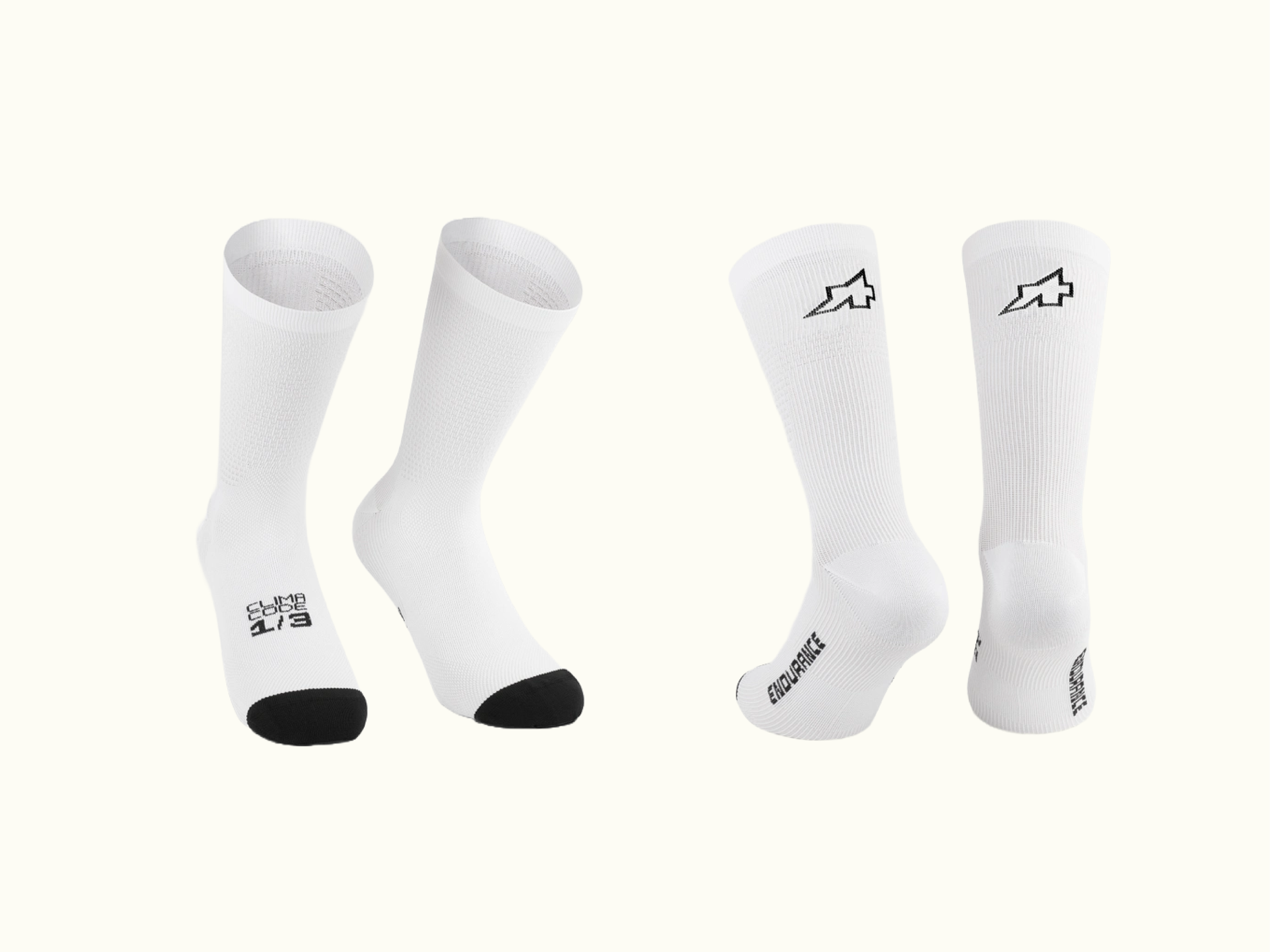
Not the race sock. The one you actually reach for. 18cm cuff, seamless construction, odour-resistant yarns mapped across the metatarsals, arch, and ankle. Lightweight, fast-drying, lightly compressive. The kind of sock that does not announce itself and does not need to. Assos has been obsessing over this object for decades. Worth every dollar.
Find here.
To submit a site, product, or whatever you’re working on, email KMC@GRAVITYHILL.CC. We read everything. Posting is never guaranteed, but curiosity always is.